


Some error occured while loading the Quick View. Please close the Quick View and try reloading the page.
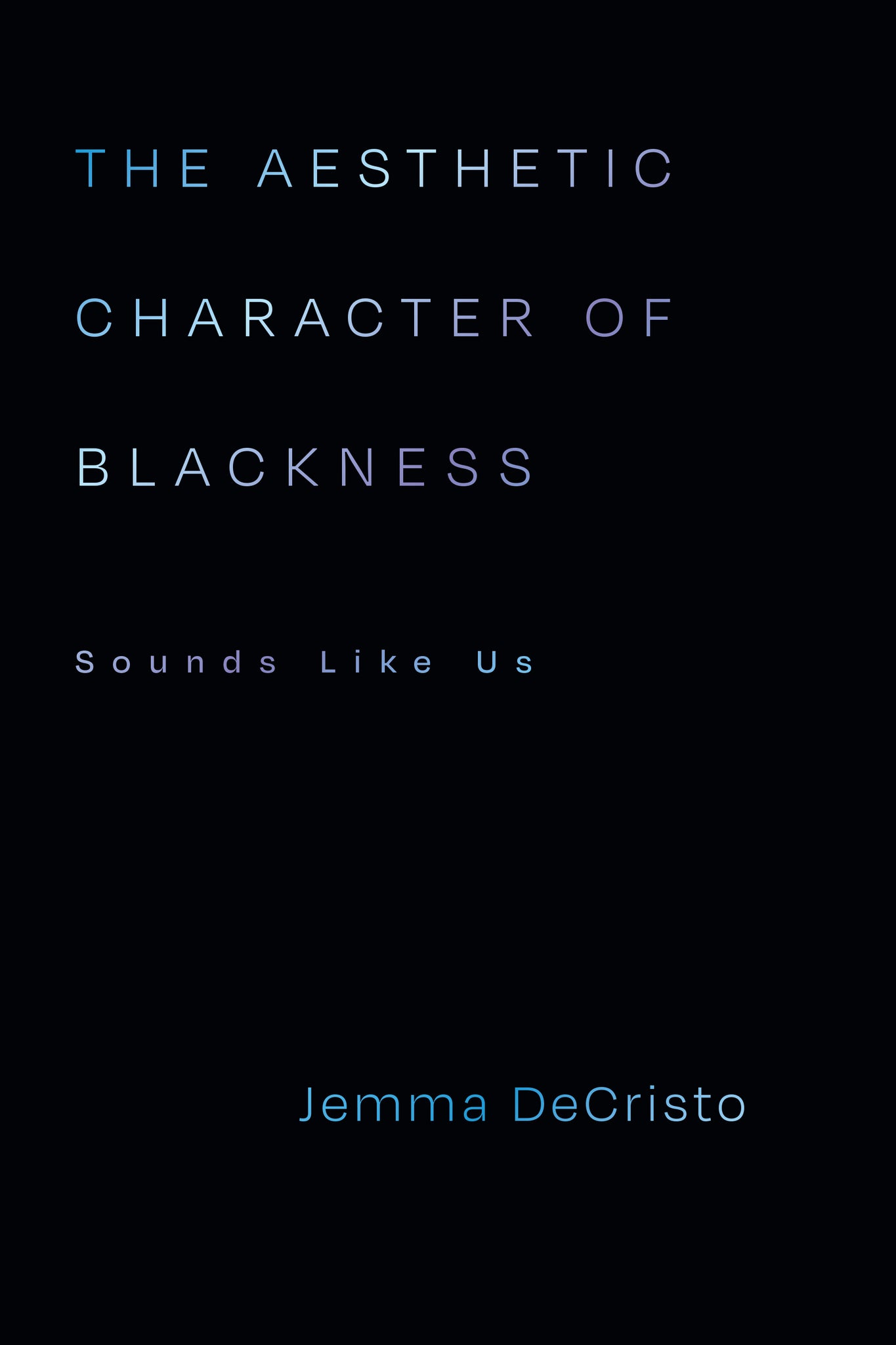
In The Aesthetic Character of Blackness, Jemma DeCristo theorizes the means by which black art liberates the free world but does not and cannot liberate black people. Drawing on Frederick Douglass, W. E. B. Du Bois, and Alain Locke and as well as the aesthetic thought of Immanuel Kant, Friedrich Schiller, Friedrich Nietzsche, and Theodor Adorno, DeCristo critiques the exaltation of black culture and art’s saving power by analyzing the violence underneath aesthetic production. She tracks black music’s representational and anti-representational capacities in projects of black non/humanization from nineteenth-century abolitionism and the founding of the recording industry to the emergence of black queer blues performers and the rise of the Black Arts Movement of the 1960s. Theorizing the contemporary neoliberalization of black audio-visual spectacle, DeCristo ultimately demonstrates that the voluptuous world of black aesthetics beautifies an anti-black world that wields black art and culture as a weapon against black life.

Price: $28.95
Pages: 288
Publisher: Duke University Press
Imprint: Duke University Press
Publication Date:
28 October 2025
Trim Size: 9.00 X 6.00 in
ISBN: 9781478032588
Format: Paperback
BISACs:
“Jemma DeCristo calls upon us to consider how ludicrous it is that a love of black culture may come at the expense of black life. Showing the ways this life remains under the yoke of captivity by means of the cultural products and aesthetic value that are mined from it, The Aesthetic Character of Blackness makes a most welcome contribution to black sound studies and is a gateway text onto the predicaments of black life in the afterlife of slavery.”—Fumi Okiji, author of, Billie’s Bent Elbow: Exorbitance, Intimacy, and a Nonsensuous Standard
“In The Aesthetic Character of Blackness, DeCristo argues that art is not a neutral zone from which creative practice happens. Turning to sound, murmurs, noise, music, DeCristo offers precise prose and persuasive passages compelling us to think differently and anew about art and beauty. She demonstrates the ways beautiful things created as art are just as often used against black folks to exacerbate displacement and harm.”—Ashon T. Crawley, author of, The Lonely Letters
“In The Aesthetic Character of Blackness, DeCristo argues that art is not a neutral zone from which creative practice happens. Turning to sound, murmurs, noise, music, DeCristo offers precise prose and persuasive passages compelling us to think differently and anew about art and beauty. She demonstrates the ways beautiful things created as art are just as often used against black folks to exacerbate displacement and harm.”—Ashon T. Crawley, author of, The Lonely Letters
Jemma DeCristo is Assistant Professor of American Studies at the University of California, Davis.
Preface. Black Art Against Black People ix
Introduction 1
1. Emancipating the Spaces of Sonic Capture 31
2. More Nearly Members of the Family: The Ugly Hiss 67
3. Ma Rainey’s Phonograph 103
4. Music Against the Subject 133
5. Sounds Like Us: On Beautification 167
Coda. Self-Defense Against Density 207
Acknowledgments 211
Notes 213
Bibliography 245
Index 261
Introduction 1
1. Emancipating the Spaces of Sonic Capture 31
2. More Nearly Members of the Family: The Ugly Hiss 67
3. Ma Rainey’s Phonograph 103
4. Music Against the Subject 133
5. Sounds Like Us: On Beautification 167
Coda. Self-Defense Against Density 207
Acknowledgments 211
Notes 213
Bibliography 245
Index 261