


Some error occured while loading the Quick View. Please close the Quick View and try reloading the page.
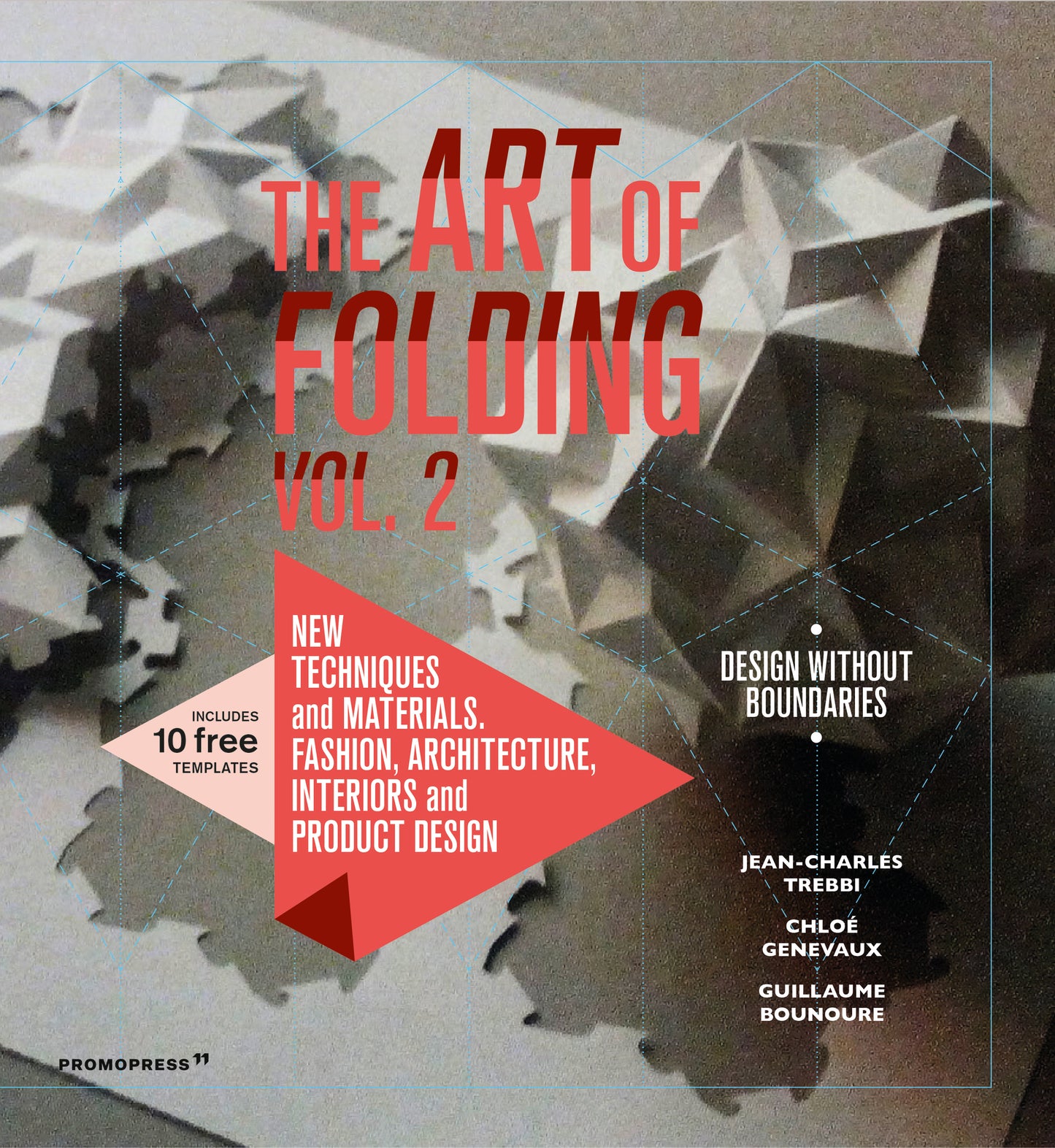
The Art of Folding 2 presents a wide range of creators who are inspired by origami and whose work with various materials draws on traditional techniques. Drawing on examples from nature, this second volume focuses on folders' know-how as it applies to art, design, decoration, fashion, furniture and lightning, architecture, new folding techniques and "intelligent" objects. In this volume architect and origami expert Jean-Charles Trebbi cooperates with the architecture partners Guillaume Bounoure and Chloé Genevaux, who specialized in experimental applications of folding techniques with new materials. The book includes ten folding templates.

Price: $35.00
Pages: 176
Publisher: Hoaki Books
Imprint: Promopress
Publication Date:
01 September 2020
Trim Size: 9.63 X 8.88 in
ISBN: 9788417412326
Format: Paperback
BISACs:
Born in Paris, Jean-Charles Trebbi is an urban architect, designer, artist and writer. A Renaissance man who specializes in the infinite possibilities of folding, cutting and assembling using paper, cardboard, textiles and even wood and metal, influenced by Bruno Munari, Katsumi Komagata, et Masahiro Chatani he creates his own art books, which are often inspired often by urban spaces and architecture, and produces completely original structures with pop-up and cutting techniques. He is author of several books on cutting, folding and pop-up techniques for all sorts of materials and on near-natural architecture.
Chloe Genevaux and Guillaume Bounoure live and work in Montpellier (France). The architect duo co-founded the collective Archiwaste which, since 2006, realizes experimental ephemeral constructions. Their research aims to give value to new or underestimated materials like cardboard. They are specialists in three-dimensional modelling of non-conventional forms based principally on folding. After realizing from 2007 to 2014 architectural projects oriented to improve environmental quality, the couple is dedicated to parametric design as part of the BOU-GE workshop they founded in 2015.
Contents
Foreword - Why folding
Inspiration - Introduction – Plant world – Anatomy – Animal world – Shadows and lights – Plastic expression – Folding kinetics – Structuring principle – Folding technology
Art - Art as folding – Origami, a gift to humanity. Representations of man. Animals and plants, Art and mathematics. The folder’s “digital” art. The expression of folding
Décor - Folding to live, folding as an art of living! Magical decorations – Enchanting decorations. Culinary arts – Tableware. Trimmings.
Fashion - Folding chic. Fabric folding and pleating traditions. Textile art. Clothing inspired by origami. Accessories
Jewellery
Furniture and lighting - Folding comfort. Folding metal. Folding plastic. Folding card. Folding wood. Space-saving folding. Body-fitting folding. Folding for folding’s sake. Lighting: folding to create light and shadow.
Architecture - Folding to drive architectural sketching. Folding for spatial organization of functions. Optimizing materials through folding. Folding to explore new perceptions of space. Folding to deploy.
Innovation - Searching is not finding - Modelling folding, from geometric model... to printed template. New folding techniques. Biomimicry. Animated and “intelligent” objects.
Models to fold - Composition of folds
Bibliography – Acknowledgments – Photo Credits
Dust jacket - Folding technologies