


Some error occured while loading the Quick View. Please close the Quick View and try reloading the page.
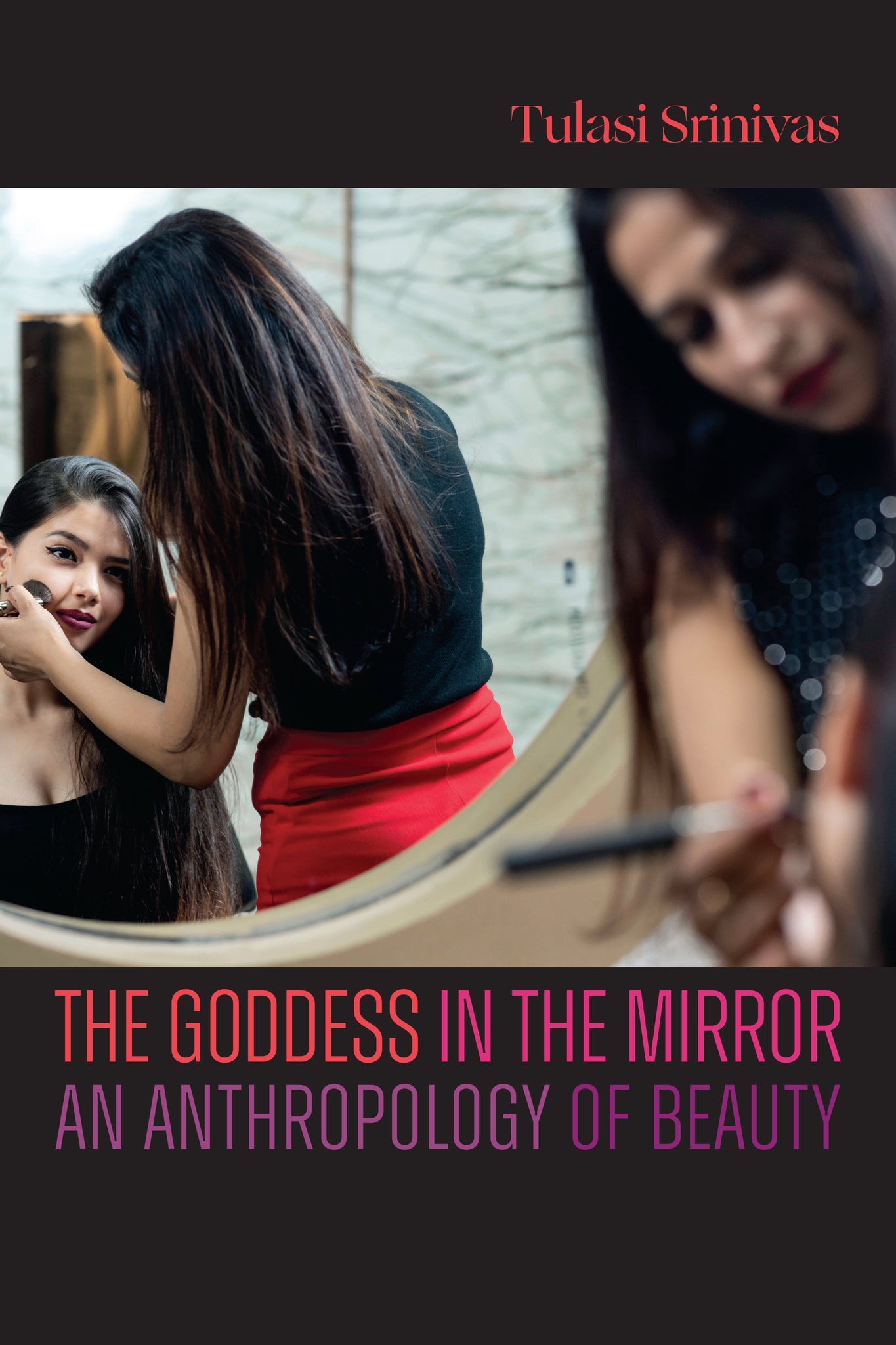
In The Goddess in the Mirror, Tulasi Srinivas offers a pathbreaking ethnography of contemporary Indian beauty parlors in Bangalore. Exploring the gendered world of beauty in the intimate spaces of the salon, whose popularity has exploded amid an urban tech revolution, Srinivas invites readers to consider what beauty is and what it does. Visiting diverse salons that cater to various classes, castes, and queer sexualities, she tracks the relationships between clients and workers, revealing the beauty industry’s painful political, religious, and economic stakes. Embodiment, religion, and narrative intersect as clients and beauticians tell well-known stories of beautiful Hindu goddesses, heroines, queens, and apsaras, thereby weaving their own ethical subjectivities every day. Following the goddess’s allure, radiance, woundedness, fluidity, and fertility, Srinivas situates ideas of beauty within a larger moral and political context where beauty is both a fleeting pursuit and a rich resource for navigating a patriarchal present.

Price: $29.95
Pages: 296
Publisher: Duke University Press
Imprint: Duke University Press
Publication Date:
04 November 2025
Trim Size: 9.00 X 6.00 in
ISBN: 9781478032779
Format: Paperback
BISACs:
“Beautifully written and creatively argued, The Goddess in the Mirror presents an original perspective on beauty work that takes us beyond predictable and reductionist framings of the subject. Tulasi Srinivas’s moving ethnography innovatively tracks how Hindu myths and stories that customers and workers narrate offer paths to becoming.”—Purnima Mankekar, coauthor of, The Future of Futurity: Affective Capitalism and Potentiality in a Global City
“The work of beauty lends itself to philosophical speculation and to a sociology of neoliberal self-making. But the odor, press, shimmer, and grit of the bodies, relations, myths, and techniques assembling the contemporary life beautiful has seldom been as palpable as in Tulasi Srinivas’ The Goddess in the Mirror. A stunning ethnographic achievement that leads its reader through the challenge and complexity of gendered recognition via situations comic, luminous, and horrifying.”—Lawrence Cohen, author of, No Aging in India: Alzheimer's, The Bad Family, and Other Modern Things
"[T]his is a valuable and nuanced book that will resonate with scholars of gender and labour, urban anthropology, South Asian studies, and anyone interested in how everyday practices become sites of political struggle. In terms of disciplinary impact, The Goddess in the Mirror may well become a touchstone for integrating aesthetic and affective dimensions into analyses of power."—Gunjan Shekhawat, LSE Review of Books
“The work of beauty lends itself to philosophical speculation and to a sociology of neoliberal self-making. But the odor, press, shimmer, and grit of the bodies, relations, myths, and techniques assembling the contemporary life beautiful has seldom been as palpable as in Tulasi Srinivas’ The Goddess in the Mirror. A stunning ethnographic achievement that leads its reader through the challenge and complexity of gendered recognition via situations comic, luminous, and horrifying.”—Lawrence Cohen, author of, No Aging in India: Alzheimer's, The Bad Family, and Other Modern Things
"[T]his is a valuable and nuanced book that will resonate with scholars of gender and labour, urban anthropology, South Asian studies, and anyone interested in how everyday practices become sites of political struggle. In terms of disciplinary impact, The Goddess in the Mirror may well become a touchstone for integrating aesthetic and affective dimensions into analyses of power."—Gunjan Shekhawat, LSE Review of Books
Tulasi Srinivas is Professor of Anthropology at Emerson College and author of The Cow in the Elevator: An Anthropology of Wonder, also published by Duke University Press.
A Note on Translation ix
Acknowledgments xi
Prelude: Reverie xv
Introduction: Beauty, Myth, Recognition 1
1. Alluring 31
2. Radiant 63
3. Hot 94
Interlude: Nightmare 120
4. Wounded 124
5. Fortunate 151
6. Fluid 179
Conclusion: Mirrors and Masks: An Anthropology of Beauty 214
Postlude: Dream 225
Notes 228
References 241
Index 267
Acknowledgments xi
Prelude: Reverie xv
Introduction: Beauty, Myth, Recognition 1
1. Alluring 31
2. Radiant 63
3. Hot 94
Interlude: Nightmare 120
4. Wounded 124
5. Fortunate 151
6. Fluid 179
Conclusion: Mirrors and Masks: An Anthropology of Beauty 214
Postlude: Dream 225
Notes 228
References 241
Index 267