


Some error occured while loading the Quick View. Please close the Quick View and try reloading the page.
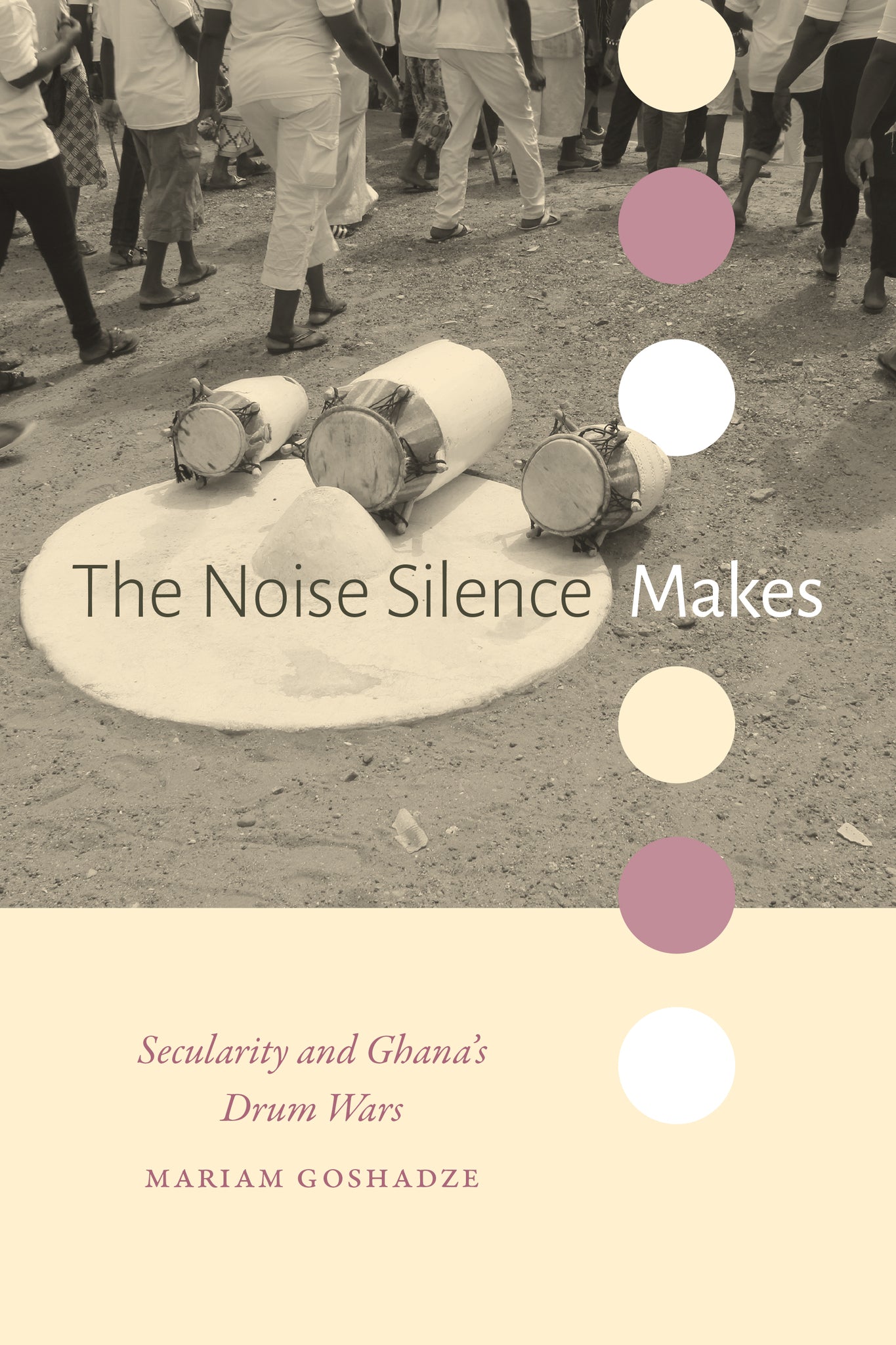
For generations, the Ga community in Accra, Ghana, has enforced an annual citywide ban on noisemaking during an important religious festival. In the 1990s and 2000s, this “ban on drumming” became a point of conflict between the Ga people and the newly popular Pentecostal/Charismatic churches, which refused to subdue their loud worship during the ban. Although the Ghanaian state constitutionally and institutionally grants superior status to Christianity and Islam, it ruled in favor of the Ga community, which emphasized its “cultural” rather than religious rights. In The Noise Silence Makes, Mariam Goshadze traces the history of noise regulation in Accra, showing how the Ga people have adopted colonial mechanisms of noise control to counter Pentecostal/Charismatic dominance over Accra’s soundscape. Goshadze shows how the drumming ban represents a reversal of the top-down model of noise regulation and illuminates the reality of Ghanaian secularity, in which the state unofficially collaborates with indigenous religious authorities to control sound. In so doing, Goshadze counters the tendency to push African “traditional religions” to the margins, demonstrating that they are instrumental players in contemporary African urbanity.

Price: $26.95
Pages: 216
Publisher: Duke University Press
Imprint: Duke University Press
Series: Religious Cultures of African and African Diaspora People
Publication Date:
30 May 2025
Trim Size: 9.00 X 6.00 in
ISBN: 9781478031413
Format: Paperback
BISACs:
“Re-sounding tensions about ‘noisemaking’ arising between Ga ‘traditionalists’ and Pentecostal/Charismatic Christians in Accra, Mariam Goshadze offers a fresh take on interreligious entanglements from a sonic angle. This amazing book breaks new ground for understanding the precarious position of ‘traditional religion’ vis-à-vis Christianity by situating it in the Ghanaian secular regime in which religion, culture, and heritage are defined and managed. A trailblazing contribution to the study of religion and secularity in Africa.”—Birgit Meyer, Professor of Religious Studies, Utrecht University
“This fascinating, innovative, and theoretically and ethnographically rich study questions the fixity in Ghana of the categories by which most political analysts define contemporary democratic nation-states. Mariam Goshadze’s argument for recognizing Ghanaian secularity as a unique formation is compelling and convincing. The Noise Silence Makes represents what is best about religious studies: its ability to analyze apparently nonreligious dynamics in productive ways through the accumulated tools of ritual analysis. A tour de force.”—Joseph Hellweg, author of, Hunting the Ethical State: The Benkadi Movement of Côte d’Ivoire
"With its focus on secularity and the engagements of a 'traditional' faith with the modern state and the Pentecostal establishment, The Noise Silence Makes makes an important contribution to the study of spiritual life in contemporary Africa."—Yotam Gidron, Material Religion
“This fascinating, innovative, and theoretically and ethnographically rich study questions the fixity in Ghana of the categories by which most political analysts define contemporary democratic nation-states. Mariam Goshadze’s argument for recognizing Ghanaian secularity as a unique formation is compelling and convincing. The Noise Silence Makes represents what is best about religious studies: its ability to analyze apparently nonreligious dynamics in productive ways through the accumulated tools of ritual analysis. A tour de force.”—Joseph Hellweg, author of, Hunting the Ethical State: The Benkadi Movement of Côte d’Ivoire
"With its focus on secularity and the engagements of a 'traditional' faith with the modern state and the Pentecostal establishment, The Noise Silence Makes makes an important contribution to the study of spiritual life in contemporary Africa."—Yotam Gidron, Material Religion
Mariam Goshadze is Assistant Professor in the Study of Religion at Leipzig University.
A Note on Orthography ix
A Note on Pronunciation xi
Introduction: Altered Ontologies and Reversed Paradigms 1
1. Jumping on the Anti-Noise Bandwagon: Drumming Permits for Accra’s Residents 25
2. Winds of Change: The Ban on Drumming Enters the Public Sphere 46
3. The Power of Sound: Cross-World Sonic Theologies 69
4. When the Deities Visit: Translating Religion into the Language of the Secular 87
5. Sacred Acoustic Inspectors: The Ghanian State and Noise Abatement during the HƆMƆWƆ Festival 108
6. Let Us Offer Thanks for the Nation of Ghana: Hɔmɔwɔ as a Civil Ceremony of Thanksgiving 133
Conclusion: Layered Epistemologies of Contemporary Accra 153
Acknowledgments 159
Glossary 161
Notes 163
References 177
Index 193
A Note on Pronunciation xi
Introduction: Altered Ontologies and Reversed Paradigms 1
1. Jumping on the Anti-Noise Bandwagon: Drumming Permits for Accra’s Residents 25
2. Winds of Change: The Ban on Drumming Enters the Public Sphere 46
3. The Power of Sound: Cross-World Sonic Theologies 69
4. When the Deities Visit: Translating Religion into the Language of the Secular 87
5. Sacred Acoustic Inspectors: The Ghanian State and Noise Abatement during the HƆMƆWƆ Festival 108
6. Let Us Offer Thanks for the Nation of Ghana: Hɔmɔwɔ as a Civil Ceremony of Thanksgiving 133
Conclusion: Layered Epistemologies of Contemporary Accra 153
Acknowledgments 159
Glossary 161
Notes 163
References 177
Index 193