


Some error occured while loading the Quick View. Please close the Quick View and try reloading the page.
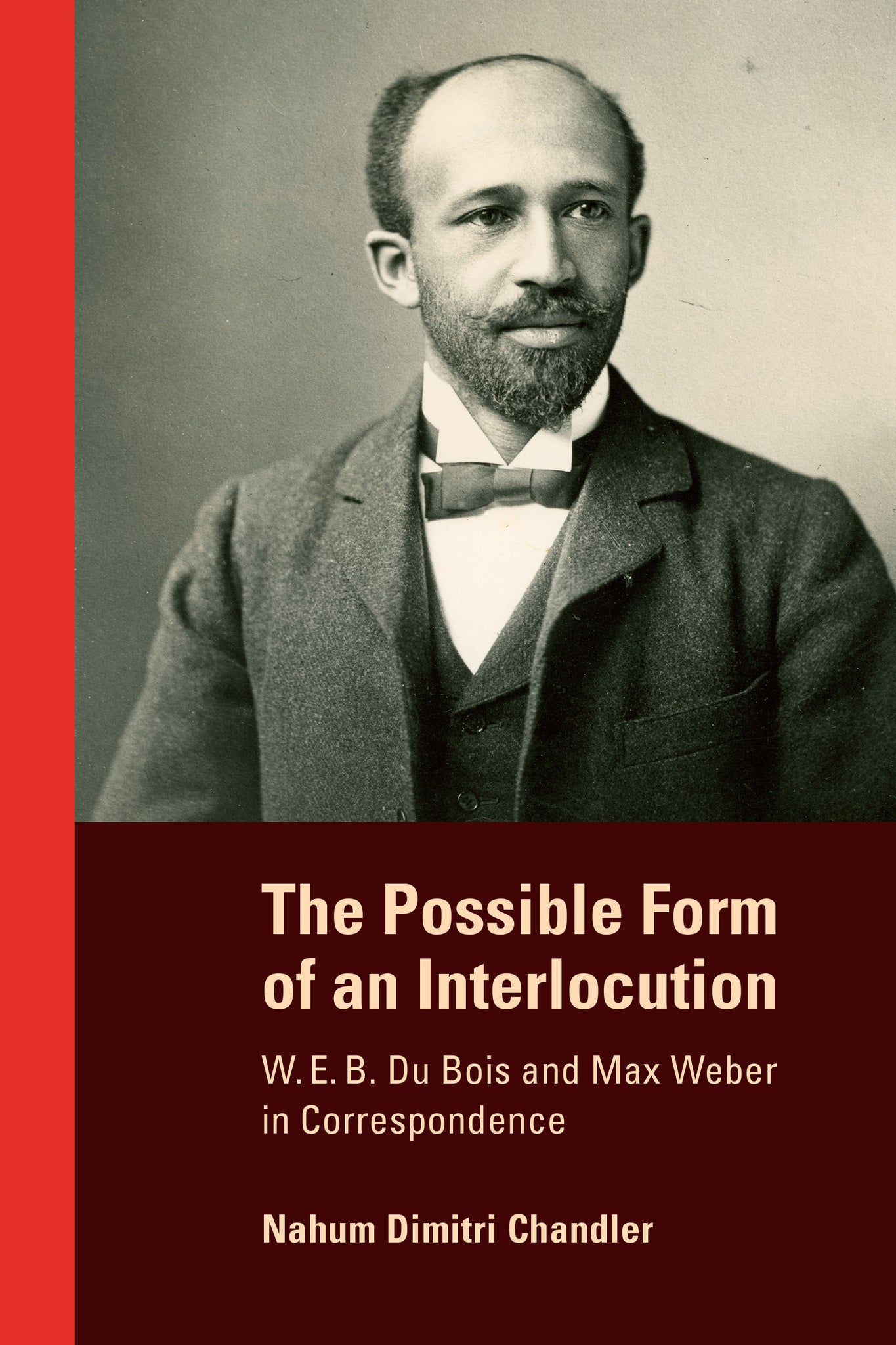
In The Possible Form of an Interlocution, Nahum Dimitri Chandler provides an epistemological and theoretical elaboration of the correspondence between W. E. B. Du Bois and Max Weber in 1904 and 1905. Their interlocution took place under the heading of Du Bois’s famous formulation “the problem of the color line.” This study takes as its incipient reference Weber’s statement to Du Bois that “I am absolutely convinced that the ‘color-line’ problem will be the paramount problem of the time to come, here and everywhere in the world.” Chandler provides a concise statement of Du Bois’s thought of “the problem of the color line” as a general formulation for understanding African American matters within modern historicity on a worldwide scale. He then examines Weber’s earliest writings to understand in just what way “the ‘color-line’ problem", served as a problematization for Weber in both his thought and itinerary, across the 1890s and through the time of their interlocution.

Price: $23.95
Pages: 224
Publisher: Duke University Press
Imprint: Duke University Press
Publication Date:
07 October 2025
Trim Size: 9.00 X 6.00 in
ISBN: 9781478032489
Format: Paperback
BISACs:
“Nahum Dimitri Chandler’s insightful archival readings make outstanding contributions to the literature on W. E. B. Du Bois and Max Weber, illuminating their interlocution beyond the untenable but widespread idea of a ‘tutelary relation’ of the latter to the former. This book does not merely promise to make an original contribution to the study of the emergence of the modern sociological paradigm; it also helps to construct the historical genealogy of a set of problems lively discussed in contemporary social and political theory.”—Sandro Mezzadra, Professor of Political Theory in the Department of the Arts, University of Bologna
“With breathtaking vision and life-giving attention to archival discoveries too, Nahum D. Chandler radically illuminates a little-known history of interlocution between two of the modern world’s most influential thinkers and that interlocution’s vital global importance for future-oriented social theories of relation, difference, and possibility itself. Now more than ever, Chandler’s brilliant parsing of futural horizons of social thought provides necessary sustenance for readers hungry for both hope and change.”—Leslie A. Adelson, Jacob Gould Schurman Professor of German Studies Emerita, Cornell University
“With breathtaking vision and life-giving attention to archival discoveries too, Nahum D. Chandler radically illuminates a little-known history of interlocution between two of the modern world’s most influential thinkers and that interlocution’s vital global importance for future-oriented social theories of relation, difference, and possibility itself. Now more than ever, Chandler’s brilliant parsing of futural horizons of social thought provides necessary sustenance for readers hungry for both hope and change.”—Leslie A. Adelson, Jacob Gould Schurman Professor of German Studies Emerita, Cornell University
Nahum Dimitri Chandler is Professor in the School of Humanities at the University of California, Irvine, and author of Annotations: On the Early Thought of W. E. B. Du Bois and “Beyond This Narrow Now”: Or, Delimitations, of W. E. B. Du Bois, both also published by Duke University Press.
Note on Citations ix
Acknowledgments xiii
An Opening Occasion xvii
Part I. The Letters and the Essay 1
1. The Correspondence Between W.E.B. Du Bois and Max Weber, 1904–1905 1
2. The Essay: W.E.B. Du Bois’s “Die Negerfrage in den Vereinigten Staaten” (1906) 17
3. The Place of “Die Negerfrage” in the Work of W.E.B. Du Bois, ca. 1905 22
Part II. The Terms of Discussion 29
1. The Virtues of Scholasticism: Annotations of the Twentieth-Century Discourse on W.E.B. Du Bois and Max Weber 34
2. The Scholasticism of the Virtual: A Problematization for Twenty-First-Century Discourse on W.E.B. Du Bois and Max Weber 43
Part III. Coda—Or, Available Light and the Terms of Discourse 79
Appendix. W.E.B. Du Bois, “Die Negerfrage in den Vereinigten Staaten” (The Negro Question in the United States) (1906) / Joseph Fracchia, Translator 87
Notes 141
References 167
Index 185
Acknowledgments xiii
An Opening Occasion xvii
Part I. The Letters and the Essay 1
1. The Correspondence Between W.E.B. Du Bois and Max Weber, 1904–1905 1
2. The Essay: W.E.B. Du Bois’s “Die Negerfrage in den Vereinigten Staaten” (1906) 17
3. The Place of “Die Negerfrage” in the Work of W.E.B. Du Bois, ca. 1905 22
Part II. The Terms of Discussion 29
1. The Virtues of Scholasticism: Annotations of the Twentieth-Century Discourse on W.E.B. Du Bois and Max Weber 34
2. The Scholasticism of the Virtual: A Problematization for Twenty-First-Century Discourse on W.E.B. Du Bois and Max Weber 43
Part III. Coda—Or, Available Light and the Terms of Discourse 79
Appendix. W.E.B. Du Bois, “Die Negerfrage in den Vereinigten Staaten” (The Negro Question in the United States) (1906) / Joseph Fracchia, Translator 87
Notes 141
References 167
Index 185