


Some error occured while loading the Quick View. Please close the Quick View and try reloading the page.
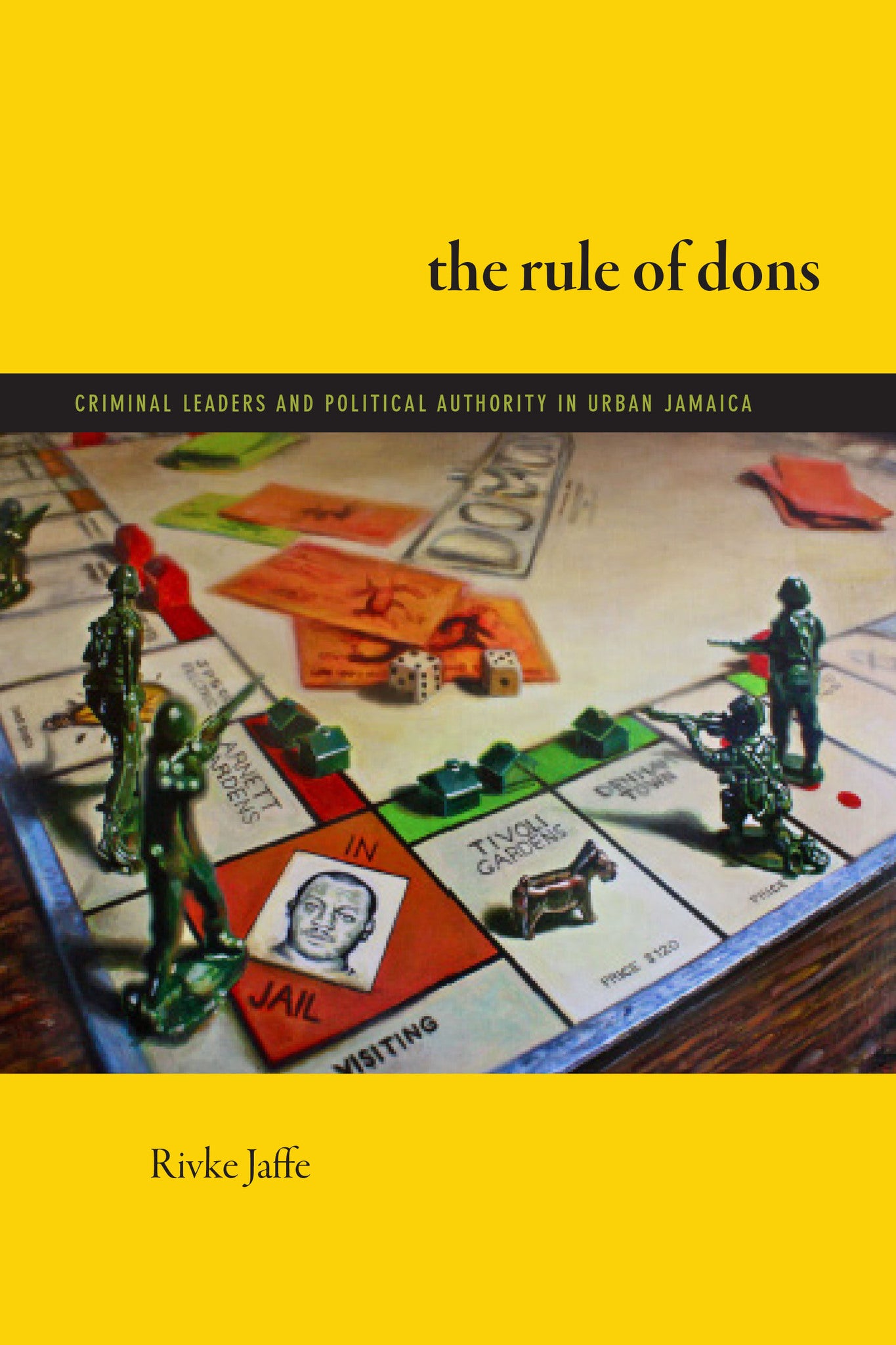
Throughout Kingston, Jamaica, figures known as “dons” exercise political authority and are seen as legitimate leaders despite their associations with crime and violence. In the absence of strong government support, they provide impoverished residents with access to security, conflict resolution, and various forms of welfare through their own resources and connections to Jamaica’s political parties. In The Rule of Dons, Rivke Jaffe shows how dons’ power relies on a widespread belief in their right to rule, explaining how criminal power is legitimized through a set of aesthetic, affective, and spatial mechanisms. She argues that dons must credibly embody an outlaw persona that stands outside of the political establishment while also connecting strategically to state institutions and mobilizing democratic ideals such as freedom and equality. As such, dons represent a form of authority that involves balancing an autocratic form of rule with an established democratic order. While donmanship represents a historically and culturally specific type of political authority, Jaffe’s analysis of this phenomenon offers insights into the entanglement of violent autocratic rule and democratic institutions far beyond Jamaica.

Price: $26.95
Pages: 216
Publisher: Duke University Press
Imprint: Duke University Press
Publication Date:
22 November 2024
Trim Size: 9.00 X 6.00 in
ISBN: 9781478031154
Format: Paperback
BISACs:
“Rivke Jaffe’s brilliant book opens windows onto the question of political legitimacy within a postcolonial context where many urban denizens have been excluded from formal political processes or mobilized as mercenaries within a partisan system. Though grounded in the realities of Jamaica, Jaffe’s insights regarding sovereignty, informality, and the power of populism stretch far beyond the region and its long histories of imperialism and plantation-based slavery. The Rule of Dons is a must-read for anyone probing the possibilities of political life, now and in the future.”—Deborah A. Thomas, author of, Political Life in the Wake of the Plantation: Sovereignty, Witnessing, Repair
“The Rule of Dons offers valuable insights into the intricate processes through which authority is legitimized and outlines how geographies of power are formed. By emphasizing the importance of spatial relations of power and influence in the performance and recognition of authority, Rivke Jaffe provides a thought-provoking exploration of these concepts and their relevance in understanding dynamics of power in urban contexts well beyond the Caribbean.”—Jovan Scott Lewis, author of, Scammer’s Yard: The Crime of Black Repair in Jamaica
"Jaffe, an intrepid ethnographer, offers a compelling, radical perspective on street gangs in Kingston, Jamaica."—Richard Feinberg, Foreign Affairs
"This book makes a valuable contribution to Caribbean studies and postcolonial scholarship. Highly recommended."—F. H. Smith, Choice
"The Rule of Dons is an innovative addition to the study of criminality and the construction of political authority, weaving together affective, esthetic, and geographical elements to analyze how power is constructed within the impoverished urban landscapes of Kingston, Jamaica."—Francisco Sánchez, Journal of Urban Affairs
“The Rule of Dons offers valuable insights into the intricate processes through which authority is legitimized and outlines how geographies of power are formed. By emphasizing the importance of spatial relations of power and influence in the performance and recognition of authority, Rivke Jaffe provides a thought-provoking exploration of these concepts and their relevance in understanding dynamics of power in urban contexts well beyond the Caribbean.”—Jovan Scott Lewis, author of, Scammer’s Yard: The Crime of Black Repair in Jamaica
"Jaffe, an intrepid ethnographer, offers a compelling, radical perspective on street gangs in Kingston, Jamaica."—Richard Feinberg, Foreign Affairs
"This book makes a valuable contribution to Caribbean studies and postcolonial scholarship. Highly recommended."—F. H. Smith, Choice
"The Rule of Dons is an innovative addition to the study of criminality and the construction of political authority, weaving together affective, esthetic, and geographical elements to analyze how power is constructed within the impoverished urban landscapes of Kingston, Jamaica."—Francisco Sánchez, Journal of Urban Affairs
Rivke Jaffe is Professor of Urban Geography at the University of Amsterdam and author of Concrete Jungles: Urban Pollution and the Politics of Difference in the Caribbean.
Acknowledgments ix
Introduction 1
1. Histories 22
2. Geographies 50
3. Electoral Politics 80
4. Law and Order 104
5. Taxation 133
Conclusion 161
Notes 169
Bibliography 181
Index 193
Introduction 1
1. Histories 22
2. Geographies 50
3. Electoral Politics 80
4. Law and Order 104
5. Taxation 133
Conclusion 161
Notes 169
Bibliography 181
Index 193