


Some error occured while loading the Quick View. Please close the Quick View and try reloading the page.
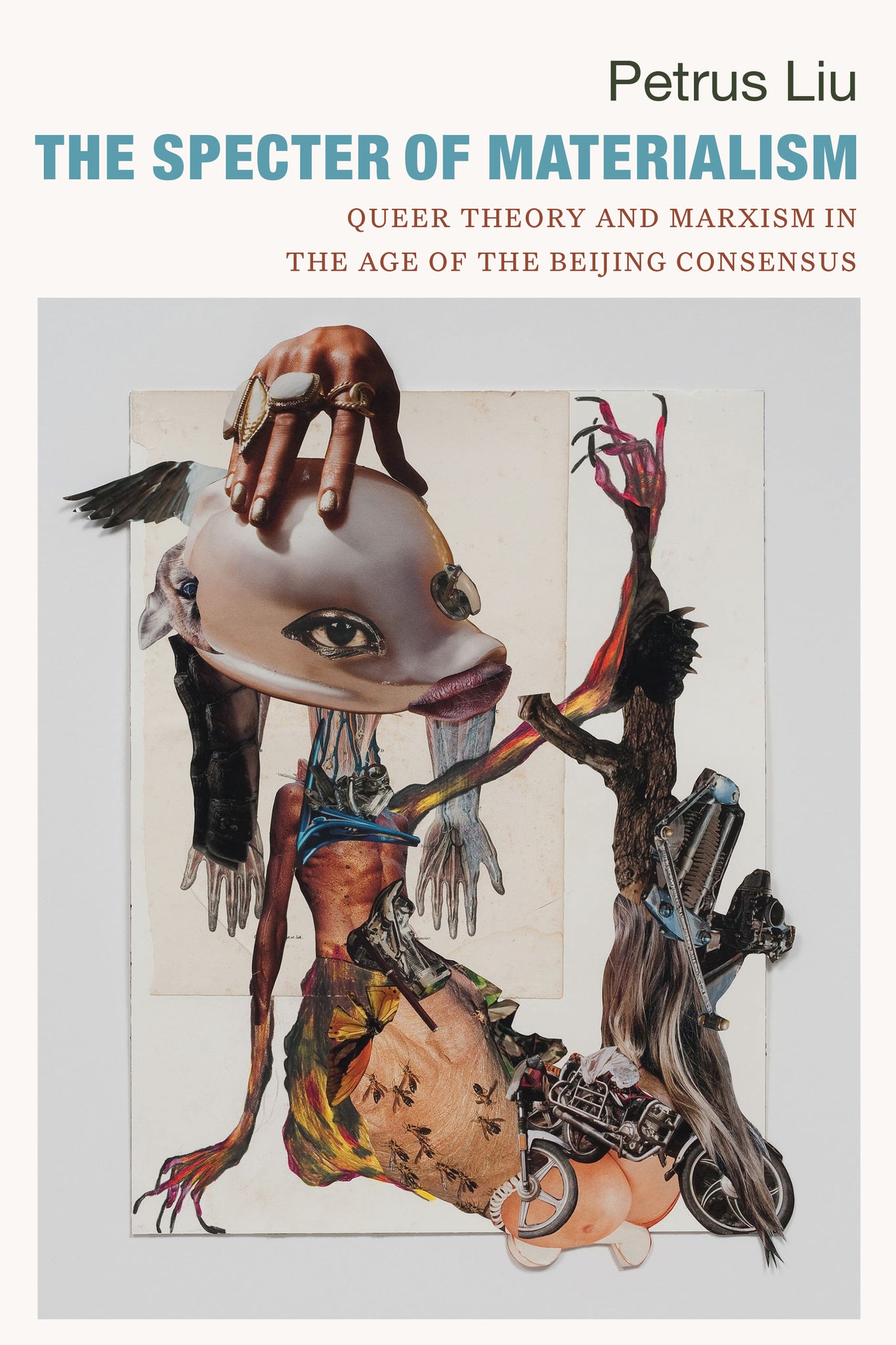
In recent years, queer theory appears to have made a materialist turn away from questions of representation and performativity to those of dispossession, precarity, and the differential distribution of life chances. Despite this shift, queer theory finds itself constantly reabsorbed into the liberal project of diversity management. This theoretical and political weakness, Petrus Liu argues, stems from an incomplete understanding of capitalism’s contemporary transformations, of which China has been at the center. In The Specter of Materialism Liu challenges key premises of classic queer theory and Marxism, turning to an analysis of the Beijing Consensus—global capitalism’s latest mutation—to develop a new theory of the political economy of sexuality. Liu explores how relations of gender and sexuality get reconfigured to meet the needs of capital in new regimes of accumulation and dispossession, demonstrating that evolving US-Asian economic relations shape the emergence of new queer identities and academic theories. In so doing, he offers a new history of collective struggles that provides a transnational framework for understanding the nexus between queerness and material life.

Price: $25.95
Pages: 256
Publisher: Duke University Press
Imprint: Duke University Press
Publication Date:
13 January 2023
Trim Size: 9.00 X 6.00 in
ISBN: 9781478019428
Format: Paperback
BISACs:
"Petrus Liu’s The Specter of Materialism is intellectually courageous and theoretically sophisticated, advancing both queer theory and Marxist thought. This review has only scratched the surface of this paradigm-shifting work. Scholars of queer theory, gender and sexuality studies, Marxism, and China Studies will all find this book indispensable for their fields."—Wenqing Kang, Modern Chinese Literature And Culture
"The Specter of Materialism is a major intervention into its announced three arenas of inquiry: queer theory, Marxism, and China. ...The product of many years of thinking and refining, Liu here extends the inquiry into asking and answering two questions: why does queer theory in China and elsewhere need Marxism, and why does Marxism need queer theory and China? These, as he shows, are intertwined problems of a global materialist history of capitalism that haunt our present, and they are problems of how to think from China about the world we currently inhabit. ... We would do well to follow Liu’s lead."—Rebecca Karl, Chinese Literature
"Petrus Liu’s work constitutes an indispensable force in both queer studies and Chinese studies."—Flair Donglai Shi, Asian Studies Review
"Together with his previous book Queer Marxism in Two Chinas, Petrus Liu’s The Specter of Materialism makes a major and invaluable contribution to creating a truly global queer Marxism. . . . Queer Marxists have a lot to learn from Liu about China’s central place in the spheres of geopolitics, economics, gender and sexuality. At the same time, queer Marxists will enthusiastically welcome his insistence that queer studies need to be far more materialist."—Peter Drucker, Dialogues in Human Geography
"A groundbreaking work. . . . This book offers insightful interventions that carry substantial significance."—Charlie Yi Zhang, Journal of Asian Studies
"Liu’s study offers a rethinking of how some parts of existing bodies, labor processes, social formations, or cultural phenomena may be partially subsumed into new ones while at the same time leaving behind spectral vestiges of their earlier formations. Liu’s project is interested in tracing that process of partial subsumption while at the same time examining its limits."—Carlos Rojas, Prism
"The Specter of Materialism is a pioneering work that charts a new path for queer materialist analysis."—Pushpraj Singh, Capital & Class
"A valuable contribution to queer studies in a new historical and geopolitical context and will be of great interest to scholars in gender and sexuality studies, China studies, Marxism, and political economy."—Wei Wei, Pacific Affairs
"The Specter of Materialism is a major intervention into its announced three arenas of inquiry: queer theory, Marxism, and China. ...The product of many years of thinking and refining, Liu here extends the inquiry into asking and answering two questions: why does queer theory in China and elsewhere need Marxism, and why does Marxism need queer theory and China? These, as he shows, are intertwined problems of a global materialist history of capitalism that haunt our present, and they are problems of how to think from China about the world we currently inhabit. ... We would do well to follow Liu’s lead."—Rebecca Karl, Chinese Literature
"Petrus Liu’s work constitutes an indispensable force in both queer studies and Chinese studies."—Flair Donglai Shi, Asian Studies Review
"Together with his previous book Queer Marxism in Two Chinas, Petrus Liu’s The Specter of Materialism makes a major and invaluable contribution to creating a truly global queer Marxism. . . . Queer Marxists have a lot to learn from Liu about China’s central place in the spheres of geopolitics, economics, gender and sexuality. At the same time, queer Marxists will enthusiastically welcome his insistence that queer studies need to be far more materialist."—Peter Drucker, Dialogues in Human Geography
"A groundbreaking work. . . . This book offers insightful interventions that carry substantial significance."—Charlie Yi Zhang, Journal of Asian Studies
"Liu’s study offers a rethinking of how some parts of existing bodies, labor processes, social formations, or cultural phenomena may be partially subsumed into new ones while at the same time leaving behind spectral vestiges of their earlier formations. Liu’s project is interested in tracing that process of partial subsumption while at the same time examining its limits."—Carlos Rojas, Prism
"The Specter of Materialism is a pioneering work that charts a new path for queer materialist analysis."—Pushpraj Singh, Capital & Class
"A valuable contribution to queer studies in a new historical and geopolitical context and will be of great interest to scholars in gender and sexuality studies, China studies, Marxism, and political economy."—Wei Wei, Pacific Affairs
Petrus Liu is Professor of Chinese and Comparative Literature at Boston University and author of Queer Marxism in Two Chinas, also published by Duke University Press, and Stateless Subjects: Chinese Martial Arts Literature and Postcolonial History.
Acknowledgments ix
Introduction: Periodizing the Post-1989 World Order 1
Part I: Theory
1. Alterity in Queer Theory and the Political Economy of the Beijing Consensus 21
2. The Specter of Materialism 52
Part II: History
3. The Subsumption of Literature: Lu Xun’s Queer Modernism in the Chinese Revolution 81
4. The Subsumption of the Cold War: The Material Unconscious of Queer Asia 104
5. The Subsumption of Sexuality: Translating Gender from the Beijing Fourth World Conference on Women to the Beijing Consensus 135
Conclusion: Toward a Transnational Queer Marxism 161
Notes 165
Bibliography 195
Index
Introduction: Periodizing the Post-1989 World Order 1
Part I: Theory
1. Alterity in Queer Theory and the Political Economy of the Beijing Consensus 21
2. The Specter of Materialism 52
Part II: History
3. The Subsumption of Literature: Lu Xun’s Queer Modernism in the Chinese Revolution 81
4. The Subsumption of the Cold War: The Material Unconscious of Queer Asia 104
5. The Subsumption of Sexuality: Translating Gender from the Beijing Fourth World Conference on Women to the Beijing Consensus 135
Conclusion: Toward a Transnational Queer Marxism 161
Notes 165
Bibliography 195
Index