


Some error occured while loading the Quick View. Please close the Quick View and try reloading the page.
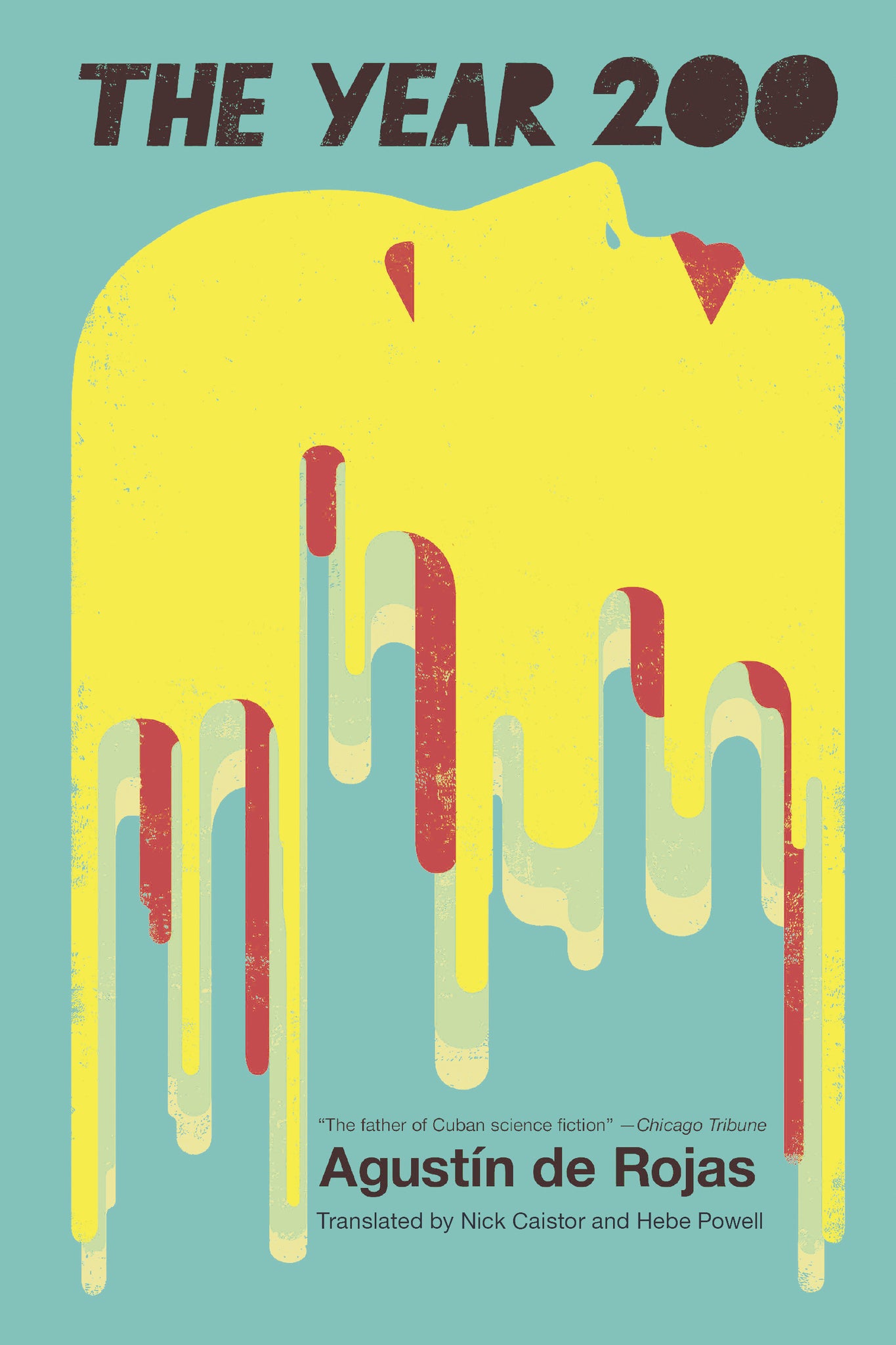
“There could scarcely be a more opportune moment for the appearance in English of the late Cuban science fiction master Agustín de Rojas’s epic novel The Year 200…. De Rojas’s lucid fictional world intersects with many of our contemporary technological obsessions but charges them with remarkably distinct political valences..... A riveting narrative of espionage and geopolitical turmoil.” —Los Angeles Review of Books
Centuries have passed since the Communist Federation defeated the capitalist Empire, but humanity is still divided. A vast artificial-intelligence network, a psychiatric bureaucracy, and a tiny egalitarian council oversee civil affairs and quash “abnormal” attitudes such as romantic love. Disillusioned civilians renounce the new society and either forego technology to live as “primitives” or enhance their brains with cybernetic implants to become “cybos.” When the Empire returns and takes over the minds of unsuspecting citizens in a scenario that terrifyingly recalls Invasion of the Body Snatchers, the world’s fate falls into the hands of two brave women.
Drawing as much from the realms of the adventure novel, spy thriller, and political satire as from hard science fiction, horror, and fantasy, The Year 200 has been proven prophetic in its consideration of cryogenic freezing, artificial intelligence, and state surveillance, while its advanced weapons and robot assassins exist in an all-too-imaginable future. Originally published in 1990, just after the fall of the Berlin Wall and before the onset of Cuba's devastating Special Period, Agustín de Rojas’s magnum opus brings contemporary trajectories to their logical extremes and boldly asks, “What does ‘the greatest good for the greatest number’ really mean?”

“There could scarcely be a more opportune moment for the appearance in English of the late Cuban science fiction master Agustín de Rojas’s epic novel The Year 200…. De Rojas’s lucid fictional world intersects with many of our contemporary technological obsessions but charges them with remarkably distinct political valences. The Year 200 is a riveting narrative of espionage and geopolitical turmoil set 200 years after the communist Confederation has defeated the capitalist Empire…. De Rojas was known as a practitioner of hard SF, and the opening chapters weave meticulous technical description with briskly paced action; co-translators Nick Caistor and Hebe Powell nicely preserve the efficiency and precision of the author’s prose…. Just as refreshing is the way that The Year 200 allows us to imagine and think along with different contradictions than the ones that we currently face…. In this moment of openness between the United States and Cuba, a place often misleadingly imagined as a time warp, there is great potential for fruitful encounters of the imagination and The Year 200 provides just such an encounter. Restless Books, and Caistor and Powell, should be commended for carrying over de Rojas’s epic into English. Translating a novel of this length and complexity, littered with a technical language that is partly invented and partly drawn from the antiquated jargon of cybernetics, is no mean feat, and they pull it off with aplomb. Thanks to these efforts, English-language readers are gaining access to the riches of Cuban science fiction, a body of literature that surely has more revelations in store for us.”
—Geoff Shullenberger, Los Angeles Review of Books
Agustín de Rojas (1949-2011) is the patron saint of Cuban science fiction. A professor of the history of theater at the Escuela de Instructores de Arte in Villa Clara, he authored a canonical trilogy of novels consisting of Espiral (Spiral, 1982), for which he was awarded the David Prize; Una leyenda del futuro (A Legend of the Future, 1985); and El año 200 (The Year 200, 1990), all of which are scheduled for publication in English translation by Restless Books. While he was heavily influenced by Ray Bradbury and translated Isaac Asimov into Spanish, de Rojas aligned himself mostly with Soviet writers such as Ivan Yefremov and the brothers Arkady and Boris Strugatsky . After the fall of the Soviet Union, de Rojas stopped writing science fiction. He spent his final years persuaded—and persuading others—that Fidel Castro did not exist.
Nick Caistor is a British journalist, non-fiction author, and translator of Spanish and Portuguese literature. He has translated Cesar Aira, Paulo Coelho, Eduardo Mendoza, Juan Marsé, and Manuel Vázquez Montalban, and he has twice won the Valle-Inclán Prize for translation. He regularly contributes to Radio 4, the BBC World Service, the Times Literary Supplement, and the Guardian. He lives in Norwich, England.
Hebe Powell lives and works in London as a freelance translator of Spanish. Born in England, she spent part of her childhood in Argentina and later, a year working and travelling in Spain. She took up a career in physics, completing a PhD in quantum optics at Imperial College London and then as a research scientist in this field. She has also worked as a science teacher. In recent years Hebe has been translating Hispano American fiction. Her first published translation, also a co-translation with Nick Caistor, was Divine Punishment by the renowned Nicaraguan author Sergio Ramírez. Hebe is also a researcher in the field of Spanish pragmatics at Birkbeck College; her work currently focuses on the linguistic strategies employed by users of an online marketplace based in Argentina.