


Some error occured while loading the Quick View. Please close the Quick View and try reloading the page.
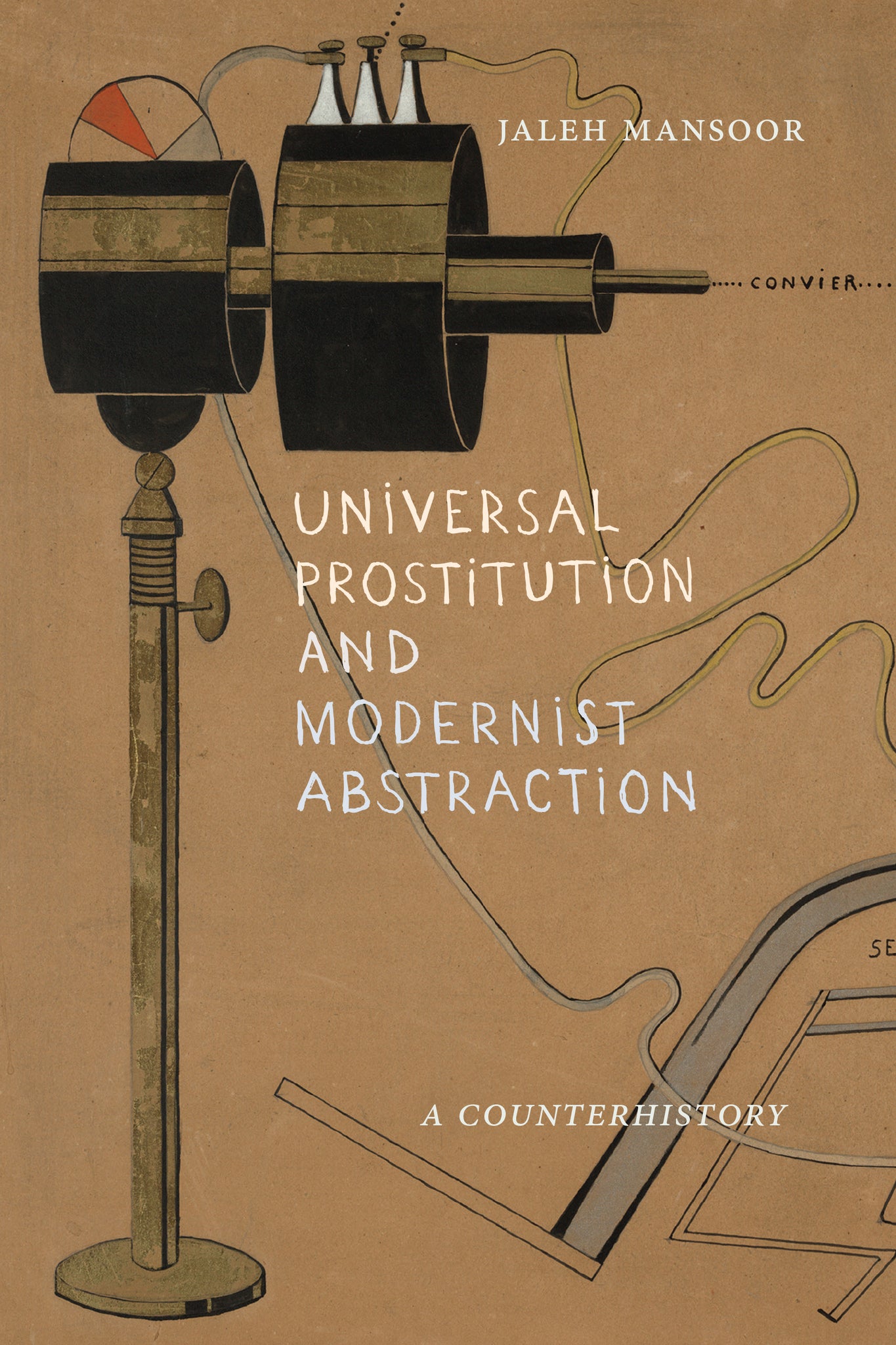
In Universal Prostitution and Modernist Abstraction, Jaleh Mansoor provides a counternarrative of modernism and abstraction and a reexamination of Marxist aesthetics. Mansoor draws on Marx’s concept of prostitution—a conceptual device through which Marx allegorized modern labor—to think about the confluences of generalized and gendered labor in modern art. Analyzing works ranging from Édouard Manet’s Olympia and Georges Seurat’s The Models to contemporary work by Hito Steyerl and Hannah Black, she shows how avant-garde artists can detect changing modes of production and capitalist and biopolitical processes of abstraction that assign identities to subjects in the interest of value’s impersonal circulation. She demonstrates that art and abstraction resist modes of production and subjugation at the level of process and form rather than through referential representation. By studying gendered and generalized labor, abstraction, automation, and the worker, Mansoor shifts focus away from ideology, superstructure, and culture toward the ways art indexes crisis and transformation in the political economic base. Ultimately, she traces the outlines of a counterpraxis to capital while demonstrating how artworks give us a way to see through the abstractions of everyday life.

Price: $35.00
Pages: 256
Publisher: Duke University Press
Imprint: Duke University Press
Publication Date:
23 May 2025
Trim Size: 9.00 X 6.00 in
ISBN: 9781478031758
Format: Paperback
BISACs:
“Featuring brilliant ideas and sharp theoretical insights, Universal Prostitution and Modernist Abstraction makes a very important contribution to the understanding of key forms and genres in twentieth-century art in general as well as to the more pointed discussion of art’s relationship to the subsumption of life under capital. I know of no other book that traces painterly abstraction and other artistic approaches to abstraction in the broader sense of the term across the longer arc of modern and contemporary art.”—Ina Blom, author of, Houses to Die In and Other Essays on Art
“Drawing on Marx’s passage on ‘universal prostitution,’ Jaleh Mansoor develops an astute analysis of the economic unconscious of modern and contemporary art. Focusing on the dialectics between aesthetic and social abstractions, Mansoor spans an arc from Seurat’s Models to Picabia’s and Tiqqun’s Young-Girls, referring to labor-reflective works by Hito Steyerl, Santiago Sierra, Hannah Black, and others. She guides us through the manifold ways art mediates the imperceptible totality of human life.”—Sabeth Buchmann, Professor of the History of Modern and Postmodern Art, Academy of Fine Arts, Vienna
"Universal Prostitution and Modernist Abstraction shows how artworks unmask the classed and gendered aspects of this topsy-turvy world in ways that other cultural objects cannot. The book will be an important touchpoint for future research into the historical entanglements of art, capital, and desire."—Thomas Waller, e-flux
"Jaleh Mansoor’s Universal Prostitution and Modernist Abstraction is a bracing reminder of what powers of insight art history and criticism can accomplish together. . . . The book offers a historically and theoretically grounded exit from current impasses in debates about the politics of representation, showing how we seek such politics in the wrong places and the wrong registers."—Natilee Harren, Artforum
“Drawing on Marx’s passage on ‘universal prostitution,’ Jaleh Mansoor develops an astute analysis of the economic unconscious of modern and contemporary art. Focusing on the dialectics between aesthetic and social abstractions, Mansoor spans an arc from Seurat’s Models to Picabia’s and Tiqqun’s Young-Girls, referring to labor-reflective works by Hito Steyerl, Santiago Sierra, Hannah Black, and others. She guides us through the manifold ways art mediates the imperceptible totality of human life.”—Sabeth Buchmann, Professor of the History of Modern and Postmodern Art, Academy of Fine Arts, Vienna
"Universal Prostitution and Modernist Abstraction shows how artworks unmask the classed and gendered aspects of this topsy-turvy world in ways that other cultural objects cannot. The book will be an important touchpoint for future research into the historical entanglements of art, capital, and desire."—Thomas Waller, e-flux
"Jaleh Mansoor’s Universal Prostitution and Modernist Abstraction is a bracing reminder of what powers of insight art history and criticism can accomplish together. . . . The book offers a historically and theoretically grounded exit from current impasses in debates about the politics of representation, showing how we seek such politics in the wrong places and the wrong registers."—Natilee Harren, Artforum
Jaleh Mansoor is Associate Professor of Art History, Visual Art, and Theory at the University of British Columbia and author of Marshall Plan Modernism: Italian Postwar Abstraction and the Beginnings of Autonomia, also published by Duke University Press.
Preface ix
Acknowledgments xv
Introduction 1. Toward a Materialist Formalism 1
Introduction 2. Modernism’s Aesthetic Economy: An Art History of Labor’s Subsumption 25
1. Georges Seurat’s Muses, Abstracted: Abstract Anonymous Labor and the Beginnings of Aesthetic Abstraction 51
2. Francis Picabia’s Real Abstraction and the Beginnings of Futurist Cyborgs: The Prefigurative Avant-Gardes 78
3. The Future of the Futurists: The Young-Girl; En/gendering Real Abstraction 104
4. The [Young-Girl] Worker as Equipment: Yves Klein’s Living Paintbrushes 133
5. Surplus Bodies: Santiago Sierra’s Exploitive Remuneration 157
Conclusion 177
Notes 197
Bibliography 213
Index 225
Acknowledgments xv
Introduction 1. Toward a Materialist Formalism 1
Introduction 2. Modernism’s Aesthetic Economy: An Art History of Labor’s Subsumption 25
1. Georges Seurat’s Muses, Abstracted: Abstract Anonymous Labor and the Beginnings of Aesthetic Abstraction 51
2. Francis Picabia’s Real Abstraction and the Beginnings of Futurist Cyborgs: The Prefigurative Avant-Gardes 78
3. The Future of the Futurists: The Young-Girl; En/gendering Real Abstraction 104
4. The [Young-Girl] Worker as Equipment: Yves Klein’s Living Paintbrushes 133
5. Surplus Bodies: Santiago Sierra’s Exploitive Remuneration 157
Conclusion 177
Notes 197
Bibliography 213
Index 225