


Some error occured while loading the Quick View. Please close the Quick View and try reloading the page.
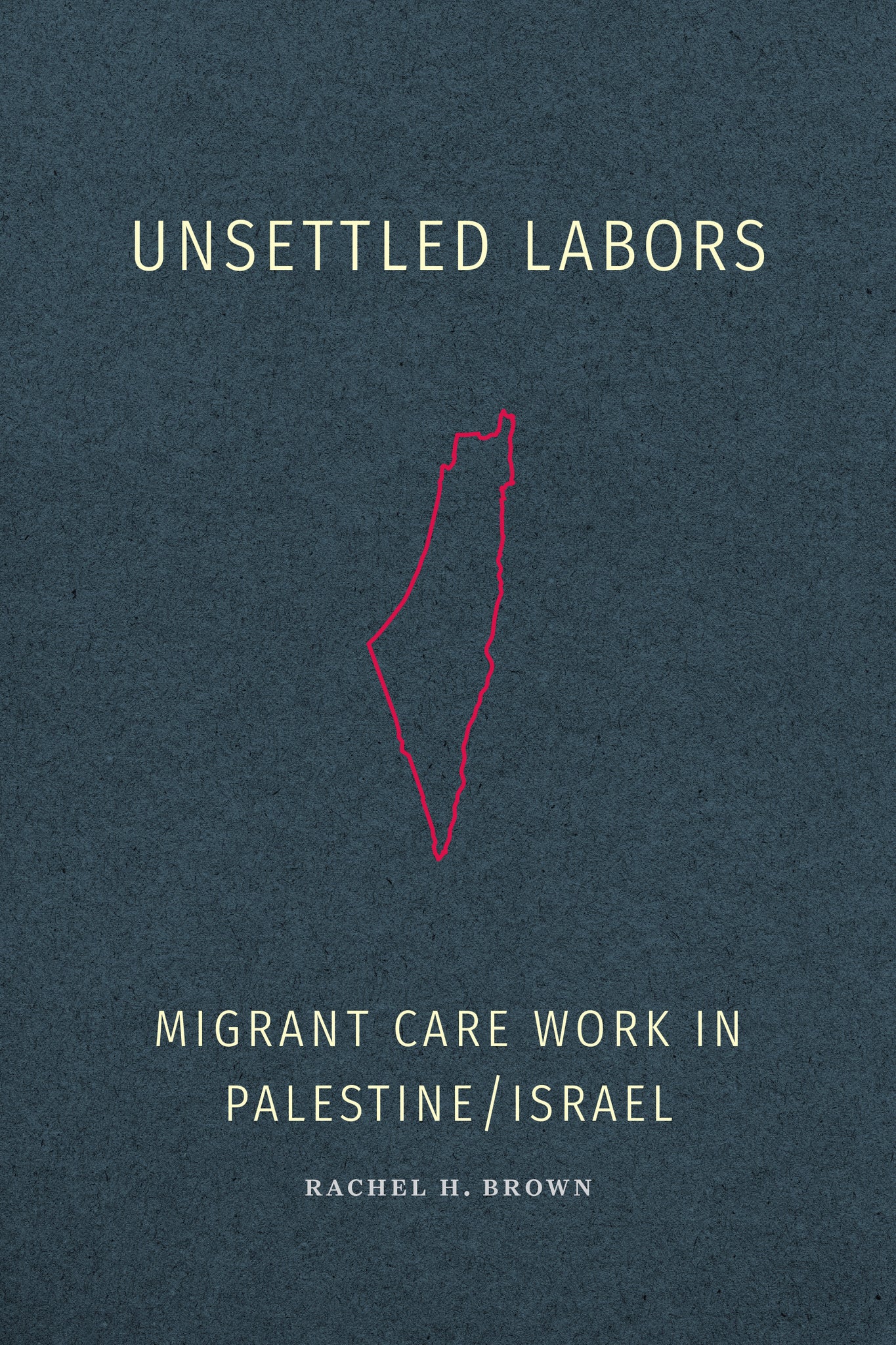
In Unsettled Labors, Rachel H. Brown explores the overlooked labor of migrant workers in Israel’s eldercare industry. Brown argues that live-in eldercare in Palestine/Israel, which is primarily done by migrant workers, is an often invisible area where settler colonialism is reproduced culturally, economically, and biologically. Situating Israeli labor markets within a longer history of imperialism and dispossession of Palestinian land, Brown positions migrant eldercare within the resulting tangle of Israeli laws, policies, and social discourses. She draws from interviews with caretakers, public statements, court documents, and first-hand fieldwork to uncover the inherently contradictory nature of elder care work: the intimate presence of South and Southeast Asian workers in the home unsettles the idea of the Israeli home as an exclusively Jewish space. By paying close attention to the comparative racialization of migrant workers, Palestinians, asylum seekers, and Mizrahi and Ashkenazi settlers, Brown raises important questions of labor, social reproduction, displacement, and citizenship told through the stories of collective care provided by migrant workers in a settler colonial state.

Price: $28.95
Pages: 328
Publisher: Duke University Press
Imprint: Duke University Press
Publication Date:
02 August 2024
Trim Size: 9.00 X 6.00 in
ISBN: 9781478030591
Format: Paperback
BISACs:
“An important intervention that critically engages decolonial and migration studies to illustrate the liminal positioning of migrant caregivers in Palestine/Israel as simultaneously aliens and intimate workers and identifies the physical and affective tolls of this labor.”—Rhacel Salazar Parreñas, author of, Unfree: Migrant Domestic Work in Arab States
“Rachel H. Brown’s central argument that there is a necessary relation between the presence of migrant care workers focused on eldercare in contemporary Palestine/Israel and settler colonialism and neoliberalism is both timely and important. This exciting book provides a robust and compelling discussion of migrant care workers’ laboring and position as we consider the ongoing Palestine/Israel conflict.”—Attiya Ahmad, author of, Everyday Conversions: Islam, Domestic Work, and South Asian Migrant Women in Kuwait
“Rachel H. Brown’s central argument that there is a necessary relation between the presence of migrant care workers focused on eldercare in contemporary Palestine/Israel and settler colonialism and neoliberalism is both timely and important. This exciting book provides a robust and compelling discussion of migrant care workers’ laboring and position as we consider the ongoing Palestine/Israel conflict.”—Attiya Ahmad, author of, Everyday Conversions: Islam, Domestic Work, and South Asian Migrant Women in Kuwait
“Brown's incisive analysis illuminates the complex social and racial hierarchies that structure Israeli society and its labor force. Her examination of these stratified power relations offers valuable insights into how ethnic, religious, and national identities intersect with labor politics in settler-colonial contexts.”
—Karim Pourhamzavi, Mashriq & Mahjar
Rachel H. Brown is Assistant Professor of Women, Gender, and Sexuality Studies at Washington University in St. Louis.
Acknowledgments vii
Introduction 1
1. The Coloniality of Israel’s Reproductive Regime 31
2. Intimacy, Alienation, and Affective Automation 63
3. Reproducing the Settler Home 101
4. Household Resistance and National Love 139
5. Collective Care and the Politics of Visibility 176
Epilogue 210
Notes 219
Bibliography 259
Index 301
Introduction 1
1. The Coloniality of Israel’s Reproductive Regime 31
2. Intimacy, Alienation, and Affective Automation 63
3. Reproducing the Settler Home 101
4. Household Resistance and National Love 139
5. Collective Care and the Politics of Visibility 176
Epilogue 210
Notes 219
Bibliography 259
Index 301