


Some error occured while loading the Quick View. Please close the Quick View and try reloading the page.
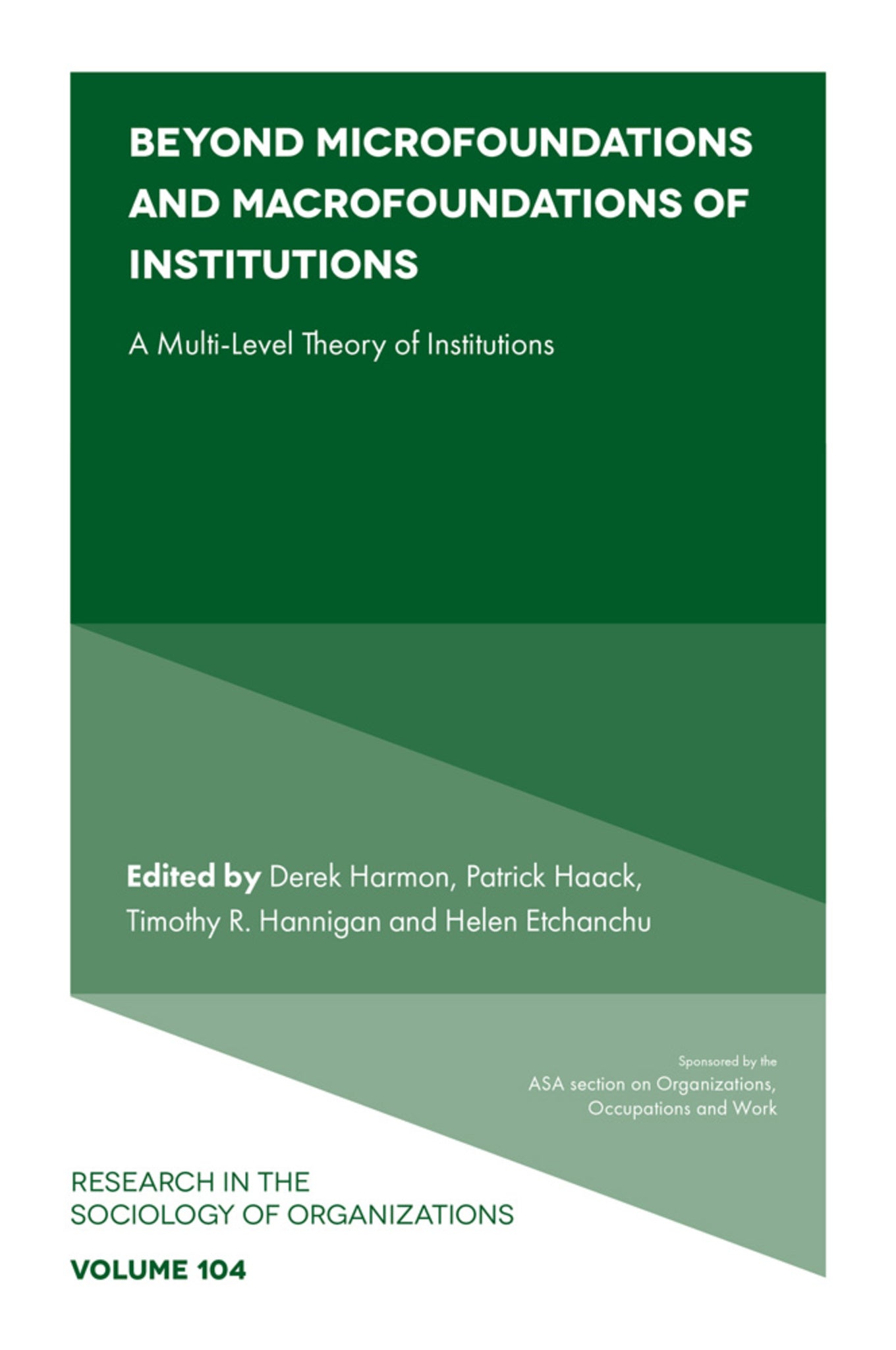
Beyond Microfoundations and Macrofoundations of Institutions challenges the binary distinction that has long constrained institutional scholarship. Transcending the limitations of Coleman’s “bathtub” metaphor, this volume advances a multilevel theory of institutions as dynamic, recursive systems. Rather than privileging micro-action or macro-structure, the contributors view institutions as a continuum where influence flows continuously across levels—from individual cognition to societal logics.
Building on previous Research in the Sociology of Organizations volumes, this collection shifts the analytical focus from static "boxes" to the "arrows" that connect them. A central theme is that communication and language serve as the critical bridge traversing these levels, enabling meanings to aggregate and disseminate. By integrating these perspectives, this volume offers a framework where constraint and agency coevolve, encouraging scholars to "lean into" the complexity of cross-level interactions.

Derek Harmon is Associate Professor at Michigan State University, USA.
Patrick Haack is Professor at the University of Lausanne, Switzerland.
Timothy R. Hannigan is Associate Professor of Strategy and Organization at the University of Ottawa's Telfer School of Management, Canada.
Helen Etchanchu was Associate Professor at Montpellier Business School, France. This volume is published in her memory.
Section 1. Introduction
Introduction; Derek Harmon, Patrick Haack, Timothy R. Hannigan, and Helen Etchanchu
Section 2. Essay
Collapsing Foundations? Integrating the Microdynamics and Macrodynamics of Institutions; Christopher W. J. Steele and Patrick Haack
Section 3. Papers
Chapter 1. From Distributed Understanding to Collective Meaning: Division of Linguistic Labor in Institutionalized Vocabularies; Jeffrey Loewenstein and Saku Mantere
Chapter 2. From Institutionalization to the Simulacra: The Repetition of Signs in Micro-Macro Dynamics; Yuan Li
Chapter 3. Semantic Surprise and Semantic Congruence as Antecedents of Legitimacy; Rodolphe Durand and Paul Gouvard
Chapter 4. Energy to Contest? Emotional and Multimodal Contestation of Institutional Infrastructure; Lianne M. Lefsrud, Hassnain Ali, Candelario A. Gutierrez Gutierrez, Joel Gehman, Denilson Barbosa, and Eleni Stroulia
Chapter 5. Microfoundations of Media Organizations; Farhan Iqbal and Michael D. Pfarrer
Chapter 6. Backed by God or Backed by Evidence? How Institutional Assumptions within the Church of England Changed through Debate; Ruben van Werven, Simon Parker, and Amit Nigam
Chapter 7. Framing Contests and Their Consequences for Institutionalizing Intractable Conflicts; Barbara Gray and Linda L. Putnam
Chapter 8. Protest as Spectacle: Challenging Dominant Institutions to Address Climate Change; Christopher Wright, Daniel Nyberg, and Vanessa Bowden
Chapter 9. Revisiting Discourse and Institutions: Exploring the Role of Digital Technology in Institutionalization; Roni Shen and Nelson Phillips
Chapter 10. Two of These Things Are Linked by Another: Commensuration and Theory Development across Analytical Levels; Hovig Tchalian
Section 4. Concluding Remarks
Concluding Remarks; Derek Harmon, Patrick Haack, Timothy R. Hannigan, and Helen Etchanchu