Skip to product information
1 of 1

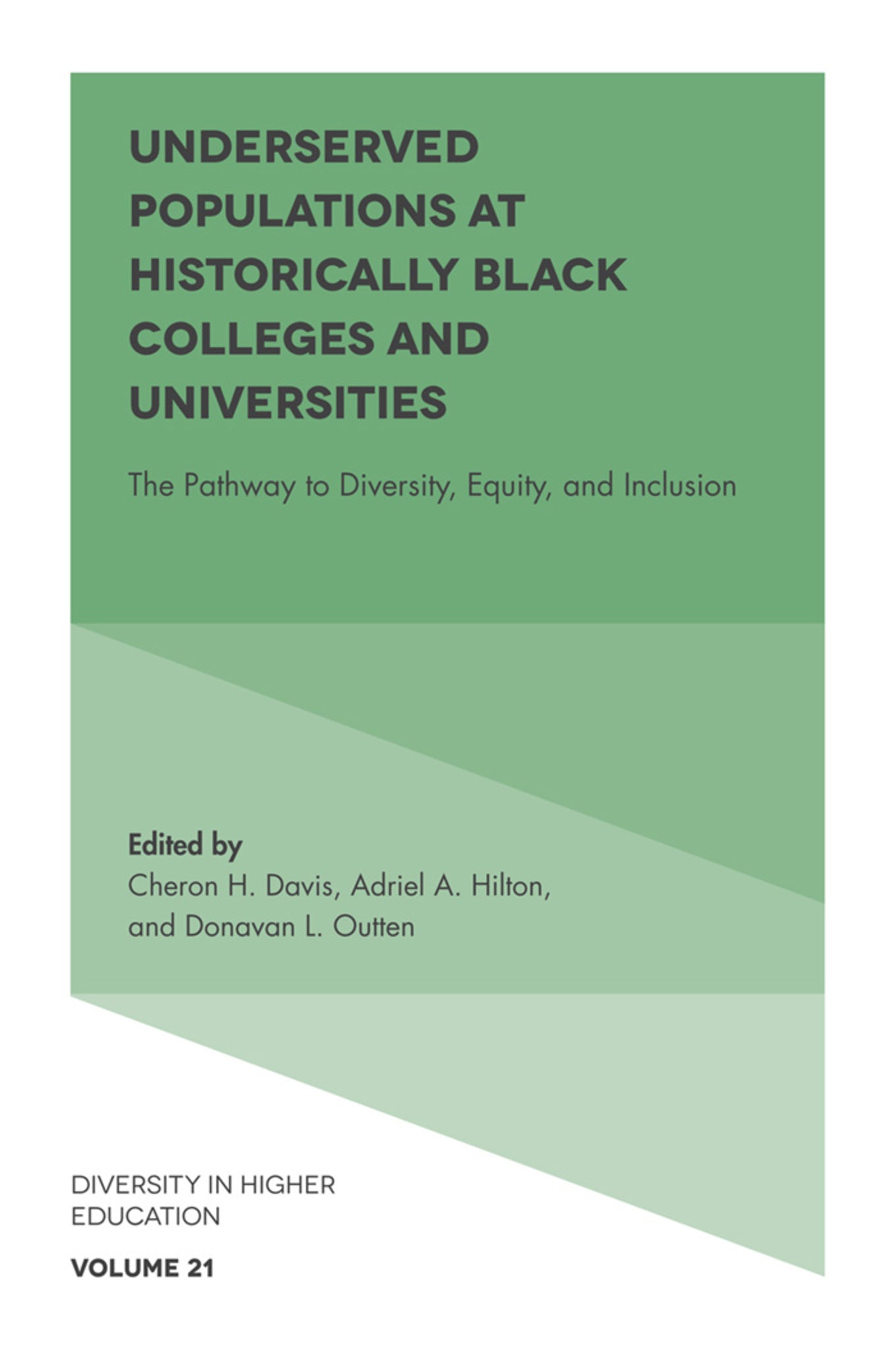
Underserved Populations at Historically Black Colleges and Universities

Regular price $145.99
Sale price $145.99 Regular price $145.99
Sale Sold out
This book focuses on the experiences of underserved student and faculty at historically Black colleges and universities. Encompassing institutional supports, identity development, and socialization...
Read More
  • Format:
  • 12 November 2018
View Product Details
This book focuses on the lived experiences of underserved student and faculty populations at historically Black colleges and universities (HBCUs) and the implications these experiences have for higher education policy. Contributors discuss the contexts and experiences of students and faculty who navigate the political and social spaces of HBCUs while supporting healthy personal and robust professional goals. 

The stigmas and social nuances that plague students and faculty of color do not dissolve with their arrival at an HBCU, but rather they transform into a new set of challenges that demand the attention of researchers. Taking into account institutional supports, identity development, and socialization patterns, this book sheds light on what the experiences of higher education’s “outsiders” mean for future research and practice, while emphasizing issues of diversity, equity, and inclusion.
files/i.png Icon
Price: $145.99
Pages: 272
Publisher: Emerald Publishing Limited
Imprint: Emerald Publishing Limited
Series: Diversity in Higher Education
Publication Date: 12 November 2018
ISBN: 9781787548411
Format: Hardcover
BISACs:

EDUCATION / Multicultural Education, Educational strategies & policy: Inclusion, SOCIAL SCIENCE / Black Studies (Global), EDUCATION / Teacher & Student Mentoring

Cheron H. Davis is Assistant Professor of Reading Education at Florida A&M University's College of Education, USA, and Co-Research Director for North Florida Freedom Schools (NFFS), a Children's Defense Fund Freedom Schools® Partner. Her research interests include teacher preparation at historically black colleges and universities, multicultural reading pedagogy, the promotion of equity and justice through literacy, and early literacy intervention techniques. 
Adriel A. Hilton is dean of students and diversity officer at Seton Hill University in Greensburg, Pennsylvania.  Recently, he served as Director of the Webster University Myrtle Beach Metropolitan Extended Campus, USA. As the Chief Administrative Officer, he was charged with implementing programs and policies to achieve Webster University's overall goals and objectives at the Extended Campus. 
Donavan Outten is Associate Vice President of Academic Affairs at Webster University, USA, where he is responsible for the extended campus network. He is a powerful trainer, consultant, educator and administrator with over 20 years' experience.
Chapter 1. Bringing the ‘Othered’ Back In: Building the Case for Diversity, Equity, and Inclusion at HBCUs; Cheron H. Davis, Adriel A. Hilton & Donavan L. Outten 
Chapter 2. A Balancing Act: Being First Still, and Faculty at an HBCU; Erica R. Russell 
Chapter 3. Serving students, faculty, and notice: Student co-operation, faculty collaboration, and institutional counter-narration at a southern flagship HBCU; William Broussard 
Chapter 4. The Contemporary Role of the HBCU in Diversity, Equity and Inclusion in the Absence of On-going Historical Relevance; Alvin Killough, Eryn Killough, James Burnett & Grover Bailey 
Chapter 5. Just Let Us Be Great!: Mentoring Students at an HBCU; Rachel B. Dunbar 
Chapter 6. White Faces in Black Spaces: Examining Faculty-Student Engagement for White Doctoral Student Success at Historically Black Colleges and Universities; Tiffany Fountaine Boykin & Larry J. Walker 
Chapter 7. Religious Minority Students at HBCUs; Yoruba Taheerah Mutakabbir 
Chapter 8. Thursdays at Five Thirty-Five; Phyllis Swann Underwood 
Chapter 9. The Role of HBCUs in Tackling Issues of Diversity, Equity, and Inclusion; Jewell Winn, Kisha Bryan, & Andrea Tyler 
Chapter 10. Challenging Cultural Norms at HBCUs: How Perceptions Impact LGBTQ Student’s Experiences; Larry J. Walker & Ramon B. Goings 
Chapter 11. Afrocentric Worldview, Hetero-Normative Ethos and Black LGBTQ Intellectuals Matriculating through Afrocentric Psychology Programs at Historically Black Colleges/Universities (HBCUs); Novell E. Tani & Simone Grier 
Chapter 12. Providing Support for non-Black Students and Faculty at HBCUs: A Promising Approach for Senior Academic and Student Affairs Officers’ (SASAOs); Henrietta Williams Pichon 
Chapter 13. Envisioning Equity: Women at the Helm of HBCU Leadership; Amanda Washington Lockett & Marybeth Gasman 
Chapter 14. Bad Board Behaviors: Undermining Growth and Development at Historically Black Colleges and Universities; Maurice C. Taylor 
Chapter 15. What’s Next?; Adriel A. Hilton, Cheron H. Davis, & Donavan L. Outten