


Some error occured while loading the Quick View. Please close the Quick View and try reloading the page.
Spring 2023 Smart Book winners from the Academics' Choice Awards
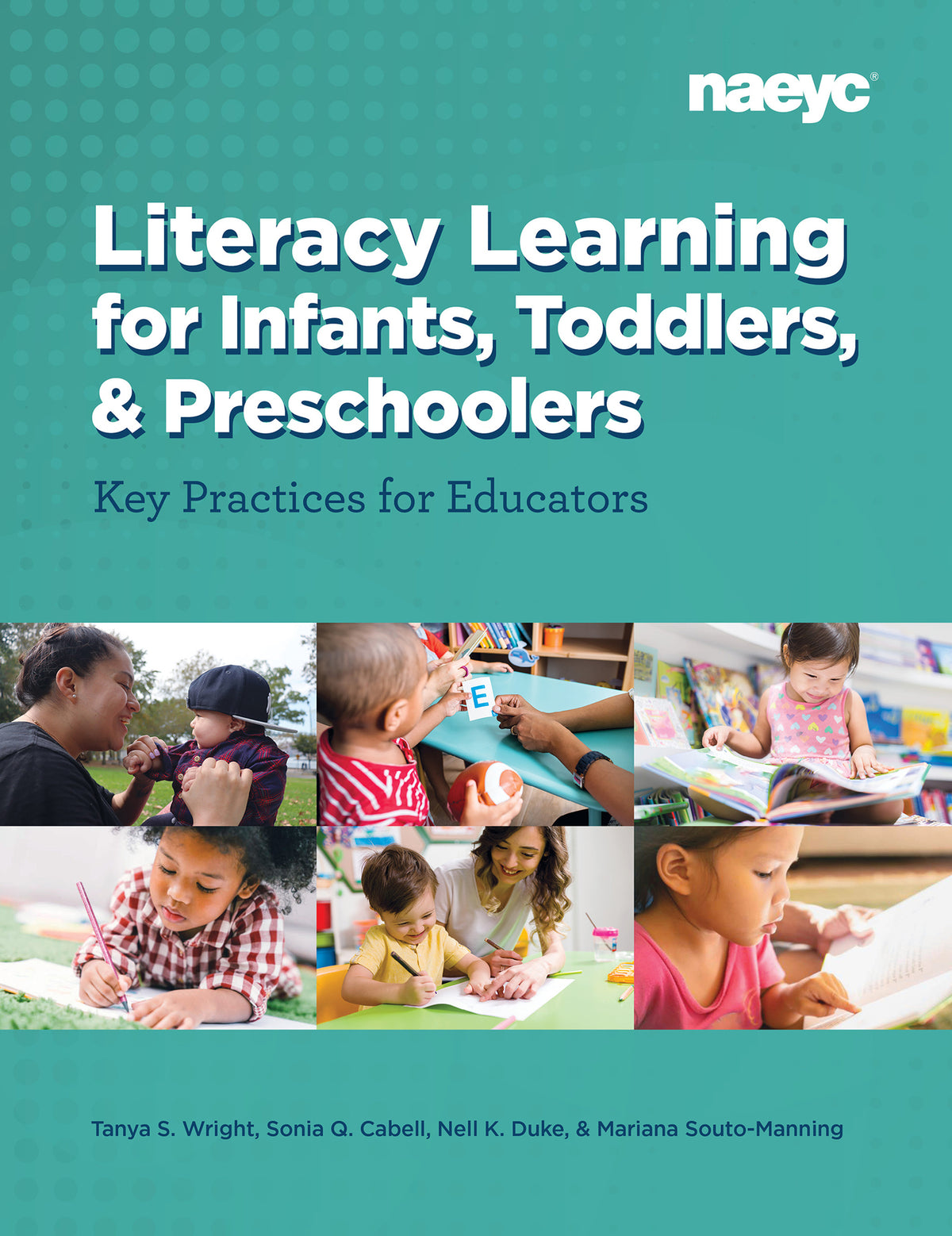
Literacy Learning begins at birth and continues throughout our lives! Birth to age 5 is a critical period in building the foundation for later success in reading and writing. Educators play a vital role in nurturing young children’s early language and literacy knowledge and skills. However, the specific practices that support literacy development in early childhood are often different than those used with older children.
From some of the foremost early literacy development experts in the field comes this practical resource that is a must-have for all educators of infants, toddlers, and preschoolers. Using eight key practices—Knowing, Showing, Designing, Including, Engaging, Explaining, Observing, and Responding—as the framework, the authors discuss how educators can support five important areas of young children’s early literacy development:
Language and knowledge
Print concepts
Sounds and letters
Writing
Text comprehension
A range of features highlights information about these areas and practices, including the latest research findings, recommended resources, tips for integrating technology into play and learning, and more.
With this book, explore how to create effective, appropriate, and fun learning opportunities for our littlest literacy learners.

Too often, educators are simply told they need to teach early literacy without being provided with support for how to engage young children in meaningful and developmentally appropriate learning experiences. This book is filled with evidence-based and easy-to-implement teaching practices that educators can put into practice immediately. The emphasis on the power of intentional environments and interactions as the pathway to supporting literacy learning for young children is aligned with everything we know about what’s important for our youngest learners.
—Bridget K. Hamre, Research Associate Professor, University of Virginia, and CEO and Cofounder, Teachstone
This is simply the best book on early language and literacy in the marketplace. It not only elucidates research and key practices in a highly informative, jargon-free way, it brings these practices to life in engaging vignettes that make them all the more real to readers.
—Susan B. Neuman, Professor of Childhood Education and Literacy Development, Steinhardt School of Culture, Education, and Human Development, New York University
If you’re thirsty for more about the science of early literacy instruction, read this brilliant book. The children you teach will benefit richly from what you learn. Parents should read it too!
—Ronald F. Ferguson, Founder and President, The Basics, Inc., and Faculty Director, Achievement Gap Initiative at Harvard University
Children’s media creators can greatly impact how children learn, but understanding how to create effective educational content can be challenging. Literacy Learning for Infants, Toddlers, and Preschoolers provides clear, concise examples of real-world learning that can easily be implemented in storytelling for children’s television and digital games.
—Olubunmi Mia Olufemi, Supervising Producer, Children’s Television
The construction of this book is early educator friendly and provides a set of comprehensive tools and resources to aid in the complexities of teaching unique learners along their continuum of early literacy development. By following the provided key practices as guideposts for language acquisition, print recognition, vocabulary expansion, and reading and writing text, educators can more readily adjust their own instructional practice using the provided cues and tips.
—Denise Smith, Implementation Director, Hope Starts Here – Detroit’s Early Childhood Partnership
Tanya S. Wright, PhD, is associate professor of literacy in the Department of Teacher Education at Michigan State University. She earned her PhD from the University of Michigan. Dr. Wright is a former kindergarten teacher whose research and teaching focus on literacy instruction during the early childhood years. She is the author of several books for teachers, including A Teacher’s Guide to Vocabulary Development Across the Day. Dr. Wright is lead author of SOLID Start, an open-access science and disciplinary literacy curriculum for grades K–2 (http://solidstart.msu.edu). She is senior editor of The Reading Teacher, a peer-reviewed journal that publishes research-based practices for literacy educators working with children up to age 12. Dr. Wright received the International Literacy Association’s Jerry Johns Outstanding Teacher Educator in Reading Award in 2022.
Sonia Q. Cabell, PhD, is associate professor of reading education in the School of Teacher Education and the Florida Center for Reading Research at Florida State University. Before receiving her PhD at the University of Virginia, she worked as a second grade teacher and literacy coach. Dr. Cabell’s research focuses on early literacy instruction with a particular interest in the prevention of reading difficulties. She has authored over 60 publications, including research articles, books, book chapters, and early childhood language and literacy curricula. She has served as principal investigator or co-principal investigator on federally funded research projects totaling approximately $9 million. Dr. Cabell has been an advisor or consultant for a variety of national organizations and state departments of education.
Nell K. Duke, EdD, is professor in literacy, language, and culture in the School of Education and the combined program in education and psychology at the University of Michigan. As of September 2022, Dr. Duke serves as the executive director of the Center for Early Literacy Success at Stand for Children (www.stand.org). She earned her bachelor’s degree from Swarthmore College and her master’s and doctoral degrees from Harvard University. Her work focuses on early literacy development, particularly among children living in economic poverty. Dr. Duke has received the International Literacy Association’s William S. Gray Citation of Merit for outstanding contributions to research, theory, practice, and policy. Her website is www.nellkduke.org.
Mariana Souto-Manning, PhD, is the fifth president of Erikson Institute in Chicago. She has served as professor of education at Teachers College, Columbia University, and held academic appointments at the University of Iceland and King’s College London. Committed to the pursuit of justice in early childhood teaching and teacher education, Dr. Souto-Manning’s research (re)centers methodologies and pedagogies on the lives, values, and experiences of intersectionally minoritized people of color. As she problematizes issues of colonization, assimilation, and oppression in schooling and society, Dr. Souto-Manning critically examines theoretical and methodological issues and dilemmas of doing research with communities of color, considering questions such as “Critical for whom?” and “According to whom?” Dr. Souto-Manning authored and coauthored 10 books, dozens of book chapters, and over 80 peer-reviewed articles. She has received a number of research awards, including the American Educational Research Association Division K Innovations in Research on Diversity in Teacher Education Award.
About the Authors
Introduction and How to Use this Book
Introduction to the purposes and structure of the book including an introduction to the eight core Practices for early childhood educators: Knowing, Showing, Designing, Including, Engaging, Explaining, Observing, and Responding.
Chapter 1: Clever Communicators
Both language and conceptual knowledge are critical for understanding texts and for learning about the world. In Chapter 1, early childhood educators learn to support young children in building knowledge, and in developing language, including vocabulary, to talk about the concepts they learn and texts that are read.
Chapter 2: Print Navigators
As children interact with different types of written text, they learn about how print is used to convey meaning. In Chapter 2, early childhood educators learn to support these understandings by encouraging children to engage with literacy materials in meaningful ways.
Chapter 3: Sound–Letter Linkers
The understanding that oral language can be broken into smaller sounds is a critical building block for literacy development. In Chapter 3, early childhood educators learn to use games and activities that encourage children to play with sounds in words.
Chapter 4: Resourceful Writers
In the early childhood years, children can begin to represent their ideas using pictures, symbols, and eventually with letters. In Chapter 5, early childhood educators learn to encourage and support children’s attempts to share their ideas through writing.
Chapter 5: Text Comprehenders
Young children can understand, enjoy, learn from, and apply ideas from texts and images. In Chapter 6, early childhood teachers learn to engage children in read alouds and other interactions with written text that facilitate language development and higher-order discussion.
Index