


Some error occured while loading the Quick View. Please close the Quick View and try reloading the page.
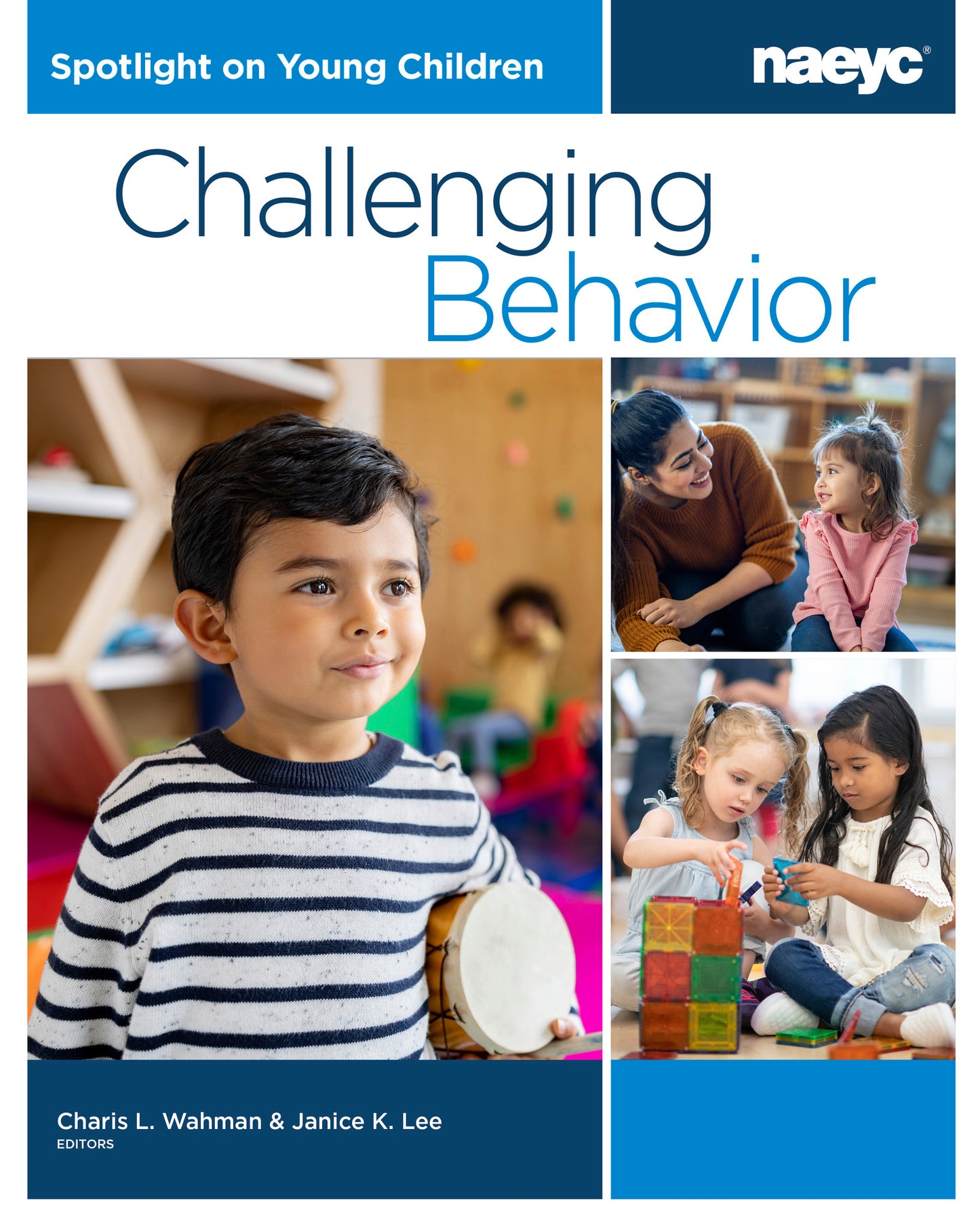
Preventing and Responding to Challenging Behavior
Addressing challenging behavior is a daily concern for early childhood educators. It’s estimated that roughly 10 to 14 percent of children from birth to 5 years old demonstrate serious behavioral concerns, resulting in significant impacts to their learning and social interactions.
Children engage in challenging behavior for many different reasons; preventing and responding to that behavior begins with understanding why it occurs. This book curates and organizes articles from Young Children and Teaching Young Children that:
- Help teachers build trust and connections with children
- Highlight evidence-based positive behavior intervention and support strategies
- Aim to prevent suspension, expulsion, and other punitive discipline
- Support teachers and families in implementing effective teaching strategies for social and emotional skills children can use instead of challenging behavior
- Show how to adapt practices to consider the cultures and contexts of children
Each article in this collection is accompanied by questions to prompt deeper thinking on the content. With this resource, fully see and hear children as you honor and support their well-being, as well as your own.

Spotlight on Young Children: Challenging Behavior provides perspective from numerous voices in the field, sorted into tiered practices from the pyramid model—preventive, targeted, and intensive and individualized. Throughout the collection, the guiding premise of cultivating environments that are relationally safe and culturally responsive is effectively conveyed. By integrating reflective questions and a message of self-care as foundational practices, this book is likely to be useful to both new and experienced early education professionals.
—Anita Osborn, Licensed Educational Psychologist and Infant-Family Early Childhood Mental Health Specialist
Everyone working with children and teachers is very aware of the dysregulation that children are exhibiting now more than ever, with behavior crying out for support and guidance. This latest excellent volume of NAEYC’s Spotlight on Young Children series is full of extremely applicable research and practical strategies that can support all of the areas educators are responsible for: tools to help us teachers stay regulated ourselves; tools to teach children about resilience and self-regulation; and tools to build compassionate classroom communities.
—Joanie Calem, Inclusion Advocate and Workshop Presenter, First Do No Harm
This resource has some very good advice for teachers and caregivers of young children, especially regarding cultural understanding and responsiveness. There are excellent suggestions for gaining an understanding of family practices and values as well as the cultures of children’s families. In addition, there are valuable tools for analyzing children’s challenging behavior with ways to reflect on how to respond.
—Nora Krieger, Associate Professor Emerita, Bloomfield College of Montclair State University
Spotlight on Young Children: Challenging Behavior offers a nuanced look at an increasingly important topic in early childhood. Each chapter provides professionals with new lenses and tools to help children learn and grow with patience and grace, even in the most difficult moments.
—Adam Holland, Technical Assistance Specialist, Frank Porter Graham Child Development Institute
Charis L. Wahman, PhD, BCBA-D, is assistant professor of special education at Michigan State University. She also serves as a clinician in early care settings to support young children with social and emotional needs. Charis has conducted research, published articles, and presented on the social and emotional development of young children and families' experiences with suspension and expulsion at national conferences.
Janice K. Lee, PhD, BCBA, is state coordinator for the Nevada Pyramid Model Partnership through the University of Nevada, Reno. In addition to conducting research and publishing articles on the pyramid model, she also provides training, coaching, consultation, and technical assistance on social and emotional skill development to teachers, practitioners, and families to prevent and address challenging behavior.
Charis L. Wahman and Janice K. Lee&
Part One: Preventive Practices
Becoming a Social and Emotional Teacher: The Heart of Good Guidance
Katherine M. Zinsser, Susanne A. Denham, and Timothy W. Curby
Culturally Responsive Strategies to Support Young Children with Challenging Behavior
Charis L. Wahman and Elizabeth A. Steed
Culturally Appropriate Positive Guidance with Young Children
Zeynep Isik-Ercan
Understanding Young Children’s Play: Seeing Behavior Through the Lens of Attachment Theory
Shulamit N. Ritblatt and Sascha Longstreth
Outdoor Recess Matters! Preventing and Reducing Children’s Challenging Behavior on the Playground
Hsiu-Wen Yang, Michaelene M. Ostrosky, Paddy Cronin Favazza, Yusuf Akemoğlu, W. Catherine Cheung, and Katherine Aronson-Ensign
Part Two: Targeted Practices
Building Meaningful Relationships: Tips for Children Who Display Challenging Behavior
Cecilia Scott-Croff and Sori Palacio
A Three-Step Approach: Promoting Young Children’s Self-Regulation and Language During Conflict
Kyla McRoy, Hope K. Gerde, and Laurie Linscott
Instead of Discipline, Use Guidance
Dan Gartrell
Responses to Challenging Behavior: Why Some Common Strategies Don’t Work and What to Do Instead
Keri Giordano, Emily Kokkinakis, and Briana Calcagno-Davi
Part Three: Intensive and Individualized Practices
Becoming a Better Behavior Detective: Applying a Developmental and Contextual Lens on Behavior to Promote Social and Emotional Development
Claire D. Vallotton, Jennifer A. Mortensen, Melissa M. Burnham, Kalli B. Decker, and Marjorie Beeghly
Functional Assessment and Positive Behavior Support: The Role of Early Learning Program Leaders and Teachers
Barbara Kaiser and Judy Sklar Rasminsky
Reducing Challenging Behavior During Transitions: Strategies for Early Childhood Educators to Share with Parents
Anne M. Butler and Michaelene M. Ostrosky
Index