


Some error occured while loading the Quick View. Please close the Quick View and try reloading the page.
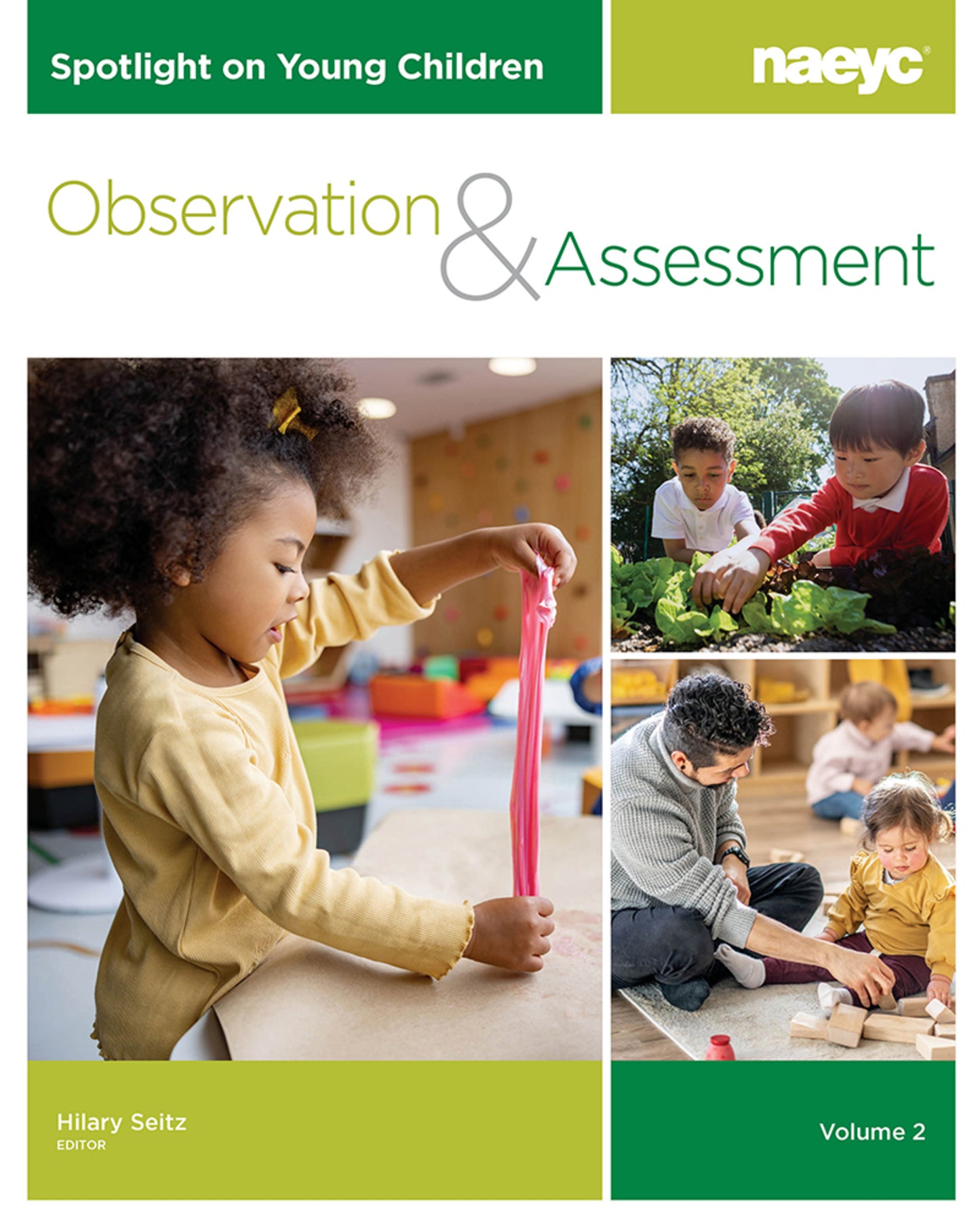
Meaningful, developmentally appropriate observation and assessment are core components of every early learning setting. In today’s world of data collection, high-stakes testing, and accountability, it is vitally important to understand how to effectively assess young children in familiar settings; use this data to inform the curriculum; and communicate this information with staff, families, and communities. <p>Carrying on the work of the first volume of <i>Spotlight on Young Children: Observation and Assessment</i>, this book brings together all-new articles curated by Hilary Seitz, director for educator and leadership programs in the California State University system. Organized into three distinct parts, the contributions <li>Discuss changing the landscape of observation and assessment <li>Emphasize the need for assessment to be culturally and linguistically responsive <li>Showcase a variety of reasons why educators use observation and assessment, exploring information about the foundations and meanings behind them <li>Highlight different facets of the authentic assessment process and how to capture thinking and learning moments <li>Address reflecting on, celebrating, and including all children by identifying their unique strengths and needs and using a variety of supporting strategies </p> <p>Each article in this collection is accompanied by questions to prompt deeper thinking on the content. With this resource, continue to grow your understanding of how observation and assessment can guide your instruction and promote children’s learning.</p>

<b>Introduction </b> <br> <i>Hilary Seitz </i> <br> <b>Part 1: Purposes of Observation and Assessment </b> <br>Foundations of Assessment for Preschool Settings <br> <i>Catherine Scott-Little, with Kathy L. Reschke </i> <br>Meaningful Assessment and Documentation: How Directors Can Support Teaching and Learning <br> <i>Debbie LeeKeenan and Iris Chin Ponte</i> <br>Assessing Agency in Learning Contexts: A First, Critical Step to Assessing Children <br> <i>Natacha Ndabahagamye Jones, Amber T. Fowler, and Jennifer Keys Adair </i> <br> <b>Part 2: Strategies for Observing and Assessing </b> <br>Authentic Assessment: A Strengths-Based Approach to Making Thinking, Learning, and Development Visible <br> <i>Hilary Seitz </i> <br>Anecdotal Records: Practical Strategies for Taking Meaningful Notes <br><i>Celeste C. Bates, Stephanie M. Madison, and Hayley J. Hoover</i> <br>Bringing Observation and Documentation to Life in Infant and Toddler Settings <br><i>Rebecca Parlakian</i> <br>Unlocking the Potential of Data-Driven Coaching: Child Assessment Evidence as a Guide for Informing Instructional Practices <br><i>Christine M. Snyder and Holly P. Delgado</i> <br>Effective Kindergarten Readiness Assessments: Influencing Policy, Informing Instruction, and Creating Joyful Classrooms
<br><i>Elliot Regenstein, Maia C. Connors, Rio Romero-Jurado, and Joyce Weiner </i> <br>Photographs and Learning Progressions:
Supports for Intentional Assessment and Instruction in Mathematics <br><i>Sarah Roller Dyess, Elizabeth Petit Cunningham, and Katherine Ariemma Marin</i> <br><b>Part 3: Assessment Practices to Support Inclusion</b> <br>Assessing Opportunities to Support Each Child:12 Practices for Quality Inclusion <br><i>Camille Catlett and Elena P. Soukakou</i> <br>Embedded Learning Opportunities for Children with and Without Disabilities <br><i>Christan G. Coogle, Emily M. Rose, Jennifer R. Ottley, Jennifer A. Brown, and Mollie K. Romano </i> <br>Authentic and Meaningful Developmental Screening in Early Childhood <br><i>Marisa Macy and Stefano J. Bagnato </i> <br>Enhancing Toddlers’ Communication Skills: Partnerships with Speech-Language Pathologists <br><i>Janet L. Gooch </i>